

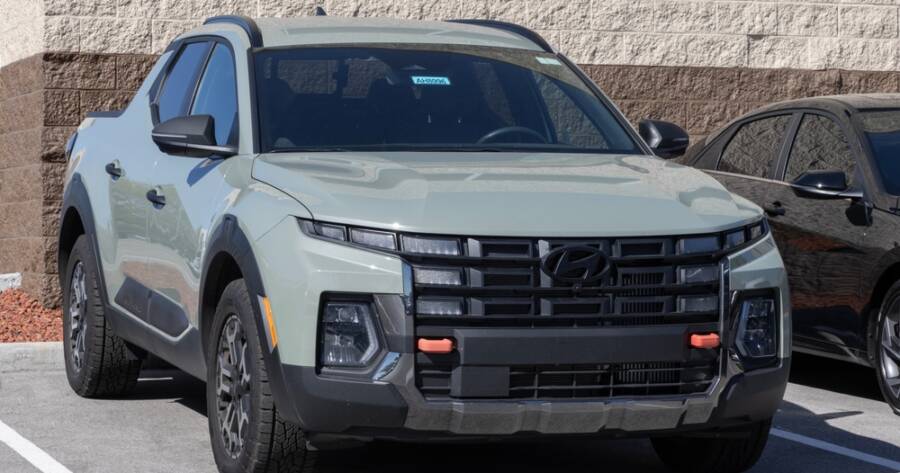
The Hyundai Santa Cruz combines the everyday comfort of a crossover SUV with the practical capabilities of a compact pickup truck. Designed for drivers who need cargo space without the bulk of a traditional truck, it offers versatile performance, modern technology, and distinctive styling. Its unconventional design makes one wonder whether the Santa Cruz can successfully serve both purposes.
A New Kind of Vehicle Category
When Hyundai introduced the Santa Cruz, it did not simply create another small truck. Instead, the automaker engineered what it calls a “Sport Adventure Vehicle,” a designation that reflects how meaningfully the Santa Cruz differs from traditional pickups (source). The result is a vehicle that handles daily commutes, weekend adventures, and cargo hauling with equal confidence, without forcing drivers to sacrifice the ride quality they expect from a modern SUV.
This hybrid identity is central to understanding the Santa Cruz’s appeal. Rather than targeting buyers who need a heavy-duty workhorse, it serves those who want practical utility alongside car-like refinement. That positioning has earned it strong recognition from automotive critics, including an Editors’ Choice award and a 9 out of 10 rating from Car and Driver (source).
Powertrain Options That Match Different Lifestyles
The Santa Cruz offers two distinct engine choices that cater to different priorities. The standard four-cylinder produces 191 horsepower and suits buyers focused on efficiency and everyday driving. Those who demand more performance can opt for the turbocharged 2.5-liter four-cylinder, which generates 281 horsepower and is paired with HTRAC All-Wheel Drive on higher trims (source).
The turbocharged variant delivers performance figures that are genuinely impressive for the segment. During independent testing, Car and Driver recorded a 0-to-60 mph time of 6.0 seconds, a number that rivals many sport-oriented crossovers (source). At highway speeds, the turbocharged engine still returned 30 mpg on a 75-mph fuel economy test, demonstrating that power and efficiency are not mutually exclusive in this package (source).
Towing and Truck Capability
For buyers concerned about whether the Santa Cruz can perform real truck duties, the numbers are reassuring. With the turbocharged engine, the Santa Cruz is rated to pull up to 5,000 pounds, a figure that matches competitors such as the Honda Ridgeline and Ford Maverick (source). That capacity is sufficient for towing a boat, a small camper, or a loaded utility trailer without straining the drivetrain.
Beyond raw towing numbers, the bed itself is thoughtfully designed. Hyundai equipped the Santa Cruz with up to six tie-down points for securing cargo, a sealed underfloor storage compartment that drains when wet, and available features like a 115-volt power outlet and a lockable integrated tonneau cover (source). These details reflect an intentional approach to utility rather than a bed that was added as an afterthought.
Trim Levels and Pricing Structure
The Santa Cruz is available in five distinct trim configurations: SE, SEL, SEL Activity, XRT, and Limited (source). The base SE trim provides an accessible entry point into the lineup, while upper trims progressively add technology, performance hardware, and premium interior features. The XRT and Limited trims bring the turbocharged engine and AWD system as standard equipment, catering to buyers who prioritize capability over cost savings (source).
Pricing spans a wide range across the lineup, starting at $31,350 for the base trim and reaching $45,300 for the fully equipped Limited (source). That spread gives buyers meaningful choices depending on budget and intended use, whether they need a capable daily driver or a loaded adventure vehicle with all available technology.
Safety Ratings and Warranty Confidence
Safety credentials further strengthen the Santa Cruz’s position. The 2026 model earned a 2025 IIHS TOP SAFETY PICK designation and a five-star overall safety rating from the National Highway Traffic Safety Administration, two of the most respected independent safety assessments in the industry (source).
Hyundai backs the Santa Cruz with warranty terms that stand out in the broader automotive market. Buyers receive a 10-year or 100,000-mile powertrain warranty, along with three years or 36,000 miles of complimentary scheduled maintenance (source). That combination of strong safety scores and generous coverage reduces long-term ownership risk considerably, making the Santa Cruz an even more attractive proposition for cost-conscious shoppers.
Why the Santa Cruz Stands Apart from Traditional Trucks
What ultimately separates the Santa Cruz from conventional compact trucks is how it prioritizes the driving experience. The cabin quality, ride refinement, and daily usability all reflect SUV-level engineering, not the utilitarian compromises that define most pickup interiors. Buyers gain an open bed and real towing capacity without surrendering the comfort they expect on long drives or congested city streets.
The competitive landscape includes capable rivals, but the Santa Cruz’s combination of safety ratings, warranty depth, powertrain flexibility, and thoughtful bed design creates a package that is difficult to replicate elsewhere in the segment. For buyers who have always felt that traditional trucks offered too many trade-offs, the Santa Cruz represents a genuinely different answer.
Why You Should Learn More About the Hyundai Santa Cruz Today
The Hyundai Santa Cruz has redefined what a compact truck can be. Its dual powertrain options, top-tier safety ratings, and innovative bed features address real-world needs that conventional vehicles often leave unmet. Backed by one of the strongest warranties in its class and recognized by leading automotive authorities, it earns serious consideration from anyone weighing a crossover against a small truck.
The Santa Cruz is not simply a compromise between two vehicle types; it is a purpose-built solution that performs confidently in both roles. Anyone exploring the compact truck market will find the Santa Cruz raises the standard significantly.