

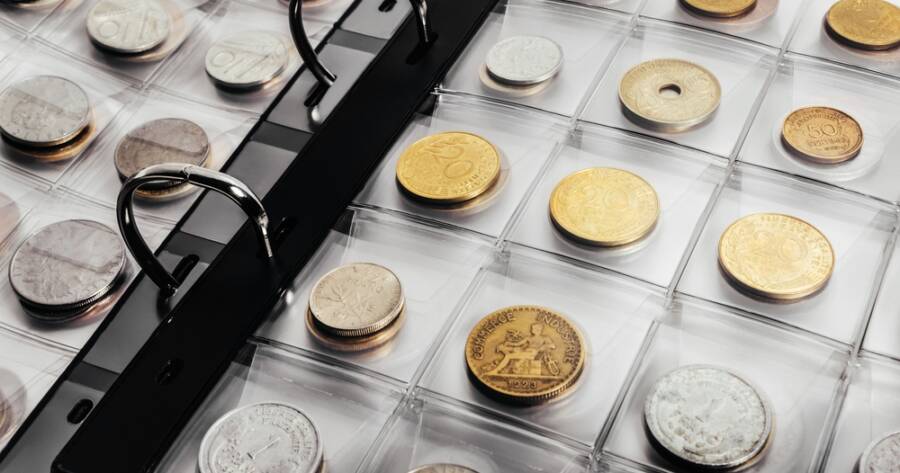
Loose change is easy to overlook, but an unusual date, mintmark, or production detail can turn an ordinary-looking coin into something collectors take seriously. Most coins are worth only their face value, yet a small number stand apart because of low production, unusual errors, or exceptional condition. Knowing what to look for can make sorting through an old coin jar much more interesting.
1. 1943 Bronze Lincoln Cent
Most Lincoln cents made in 1943 were struck in zinc-coated steel because copper was needed for the war effort, but a tiny number were accidentally produced on leftover bronze planchets. That mistake created one of the most famous rarities in American coin collecting.
PCGS estimates that only about 10 to 15 Philadelphia bronze examples are known and currently lists brown specimens around $235,000 in XF40 and $390,000 in MS60, while exceptionally preserved examples can be worth considerably more. A normal 1943 steel cent is far more common, so authentication is essential before assuming a copper-colored example is genuine (source).
2. 1955 Doubled Die Obverse Lincoln Cent
The 1955 Doubled Die Obverse Lincoln cent is recognizable by prominent doubling on the date and lettering, particularly “LIBERTY” and “IN GOD WE TRUST.” Unlike minor machine doubling, the effect was created during preparation of the die and appears dramatically on genuine examples.
PCGS notes that many brown examples trade around $2,500 to $3,000 in grades up to AU58, while attractive red examples in higher Mint State grades can reach $15,000 or more. Exceptional certified pieces have sold for substantially higher amounts at auction (source).
3. 1932-D Washington Quarter
The 1932-D Washington quarter stands out because only 436,800 were struck at the Denver Mint, making it one of the key dates of the series. Condition has an enormous effect on value.
PCGS currently lists examples around $80 in Good condition, roughly $230 in Extremely Fine, about $1,100 in MS60, and around $7,250 in MS65. The small “D” mintmark appears on the reverse, and collectors should be cautious because valuable mintmarks can sometimes be altered or added to otherwise common coins (source).
4. 1916-D Mercury Dime
With a mintage of only 264,000, the 1916-D Mercury dime is the lowest-mintage regular circulation issue in the Mercury dime series and remains highly sought after. NGC’s 2026 price guide places circulated examples roughly between $850 and $12,650 depending on grade, with Mint State coins potentially commanding much more. The coin is also frequently counterfeited by adding a “D” mintmark to a more common 1916 Philadelphia dime, making professional authentication particularly important for anyone who believes they have found one (source).
5. 1921 High Relief Peace Dollar
The first Peace dollars issued for circulation in 1921 feature a distinctive high-relief design that was reduced in later years, giving the original issue added collector appeal. PCGS currently values a heavily circulated example at around $170, while an XF40 example is roughly $260 and an MS60 coin about $650.
A well-preserved MS65 example can reach around $4,000, with particularly high-grade pieces worth considerably more. Because condition changes the value so dramatically, even two genuine 1921 Peace dollars can have very different market prices (source).
What to Check Before Selling a Coin
Before assuming a coin is valuable, check the date, mintmark, condition, and any unusual design details against reputable references from organizations such as PCGS or NGC. Avoid cleaning, polishing, or scrubbing a coin in an attempt to improve its appearance. PCGS warns that cleaning can disturb the original surface and reduce collector value, even when the coin looks brighter afterward (source). Valuable issues such as the 1916-D Mercury dime are also frequent targets for alterations and counterfeits, making third-party authentication particularly useful when a potentially rare coin is involved (source).
Price guides should also be treated as references rather than guaranteed selling prices. A coin’s actual value can change according to its certified grade, eye appeal, rarity, market demand, and recent auction activity. Professional grading may make sense for a potentially scarce or valuable piece, but the cost is not necessarily worthwhile for ordinary coins. Comparing recent certified values and consulting a reputable coin dealer can help determine whether further evaluation makes sense.
A Closer Look Can Make a Difference
Most pennies, dimes, quarters, and dollars will never become major collectibles, but a handful of dates and varieties show why it pays to look before spending or exchanging older coins. A tiny mintmark, obvious doubling, unusual metal composition, or scarce year can completely change how collectors view a piece.
The 1943 bronze cent, 1955 doubled-die cent, 1932-D quarter, 1916-D Mercury dime, and 1921 Peace dollar are very different coins, yet each demonstrates how rarity and condition can create collector demand. Learning to recognize those details is the first step toward finding out whether an ordinary-looking coin deserves a second look.