

Jewelry from the 1950s remains highly appealing to vintage collectors, but some pieces attract far more attention than others. Signed costume jewelry, distinctive brooches, colorful plastics, sparkling crystals, and well-preserved matching sets can all stand out in the resale market. Knowing the decade’s key designers, materials, and construction details can make it much easier to recognize genuinely desirable finds.
The Cultural Backdrop Behind 1950s Jewelry
Post-war prosperity reshaped American consumer culture in dramatic ways, and jewelry was no exception. A booming middle class developed a taste for pieces that projected optimism, femininity, and social status. Fashion itself became a vehicle for self-expression at every income level, and jewelry designers (both fine and costume) rose to meet the moment with bold, imaginative output.
The growing influence of Hollywood glamour combined with the rise of television made stylish accessories more visible than ever before. Women dressed carefully, pairing their outfits with coordinated jewelry that signaled both taste and prosperity. The era’s appetite for matching sets, or demi-parures, reflected this cultural emphasis on polished presentation, with suites that combined necklaces, earrings, brooches, and dress clips into cohesive ensembles (source).
Brooches: The Defining Accessory of the Decade
No piece of 1950s jewelry captures the spirit of the decade quite like the brooch. Naturalistic themes dominated, with flowers, leaves, feathers, and whimsical animal forms appearing across fine and costume collections alike, often accented with enamel and colorful gemstones (source). Fashion itself reinforced the brooch’s visibility, as women’s suits of the era featured deep chest pockets specifically designed to frame clusters of these eye-catching pins (source).
Among the most coveted brooches for today’s collectors are Trifari’s Jelly Belly pins. These gold-plated pieces featured rhinestone trim and a translucent Lucite cabochon at their center, crafted into charming animal forms including frogs, seals, poodles, and roosters. “Original Trifari Jelly Bellies can command vast sums” in today’s secondary market, says Vintage Dancer (source). Their blend of playful design and quality craftsmanship makes them particularly appealing to serious collectors.
Bracelets: Charm and Glamour on the Wrist
The 1950s transformed the bracelet from a simple adornment into a deeply personal artifact. Charm bracelets became a cultural phenomenon, serving simultaneously as jewelry and as a form of autobiographical storytelling. Wearers loaded chain link or bangle styles with as many individual charms as possible, each piece representing a memory, milestone, or personal interest (source). Vintage charm bracelets with their original charms intact are among the more emotionally resonant finds in mid-century collecting.
Fashion trends of the era also elevated the status of the bracelet in general. Clothing silhouettes of the period — twin sets and long-sleeved shirts designed to end just above the wrist — were specifically styled to showcase whatever bracelet the wearer chose, whether a chunky statement cuff or something that caught the light (source). By the late 1950s, gold chain bracelets and necklaces had become fashionable staples, typically set in the warm yellow-toned gold that defined the decade’s preferred aesthetic (source).
Diamonds, Pearls, and the Rise of Rhinestones
Fine jewelry in the 1950s orbited closely around diamonds, partly due to the enduring success of DeBeers’ “A Diamond is Forever” campaign, which positioned diamonds as meaningful purchases accessible to middle-class buyers by promoting smaller stones as well as large ones (source). Platinum settings paired with diamonds remained synonymous with prestige, particularly in suites designed for evening wear.
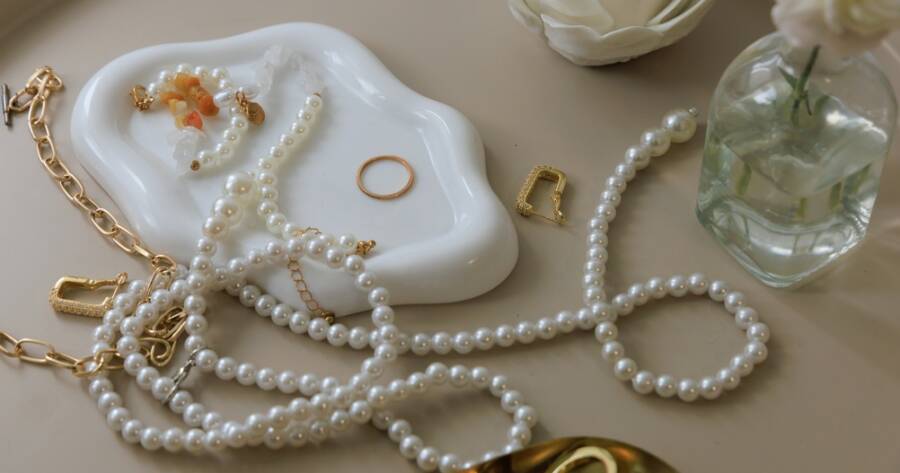
Pearls also enjoyed enormous popularity throughout the decade, carrying associations with refined femininity that aligned perfectly with prevailing social ideals. Costume jewelry, however, offered its own form of brilliance. Christian Dior, working alongside Swarovski, helped develop the Aurora Borealis stone, a glass gem engineered to produce an iridescent, rainbow-like sparkle that became a hallmark of 1950s evening accessories (source). Pieces featuring this distinctive stone are highly recognizable and remain popular among collectors today.
Materials and Settings That Define the Era
Identifying authentic 1950s jewelry often comes down to understanding the materials and construction methods that were characteristic of the period. Yellow-toned gold dominated fine jewelry settings, with textured gold surfaces appearing throughout the decade as a signature aesthetic choice (source). Lucite plastic, meanwhile, played a surprisingly prominent role in costume pieces, lending translucency and color to brooches and earrings in ways that glass and metal alone could not replicate.
Rhinestones were ubiquitous in mid-price and costume ranges, bringing accessible sparkle to a wide audience. Enamel detailing added rich color to zoomorphic brooches and floral designs, while bold colored gemstones in gold settings satisfied the era’s love of vibrancy. Collectors who develop familiarity with these period-specific material signatures are much better positioned to distinguish genuinely vintage pieces from later reproductions.
Notable Designers and Labels Worth Knowing
Several jewelry houses produced work during the 1950s that remains highly collectible. Trifari stands among the most recognized names, celebrated for both its Jelly Belly series and broader costume line. Christian Dior’s jewelry collaborations brought haute couture sensibility to wearable accessories, producing pieces that straddled the line between fashion statement and collectible art object (source). Recognizing original hallmarks, tags, and construction details associated with these labels can meaningfully affect the value and authenticity of a find.
Lesser-known regional and unsigned pieces also hold genuine appeal for collectors with a sharp eye. The combination of quality construction, period-accurate materials, and strong design can make an unsigned brooch or bracelet just as rewarding a find as a labeled designer piece. Building knowledge of the decade’s visual vocabulary is ultimately the most reliable tool any collector can develop.
Why You Should Learn More About 1950s Vintage Jewelry
The jewelry produced during the 1950s represents a remarkable intersection of craftsmanship, cultural history, and wearable artistry. Brooches still carry the optimism of the post-war era. Charm bracelets preserve personal stories in metal and enamel. Aurora Borealis rhinestone pieces bring a distinctive iridescent magic that no other decade replicated in quite the same way.
Whether the interest is in fine diamonds and gold or in playful Lucite animal pins, the 1950s offer something genuinely rewarding for collectors at every level of experience. Understanding the key designers, materials, and stylistic signatures of the period transforms a casual interest into informed, confident collecting that yields both aesthetic pleasure and lasting value.