

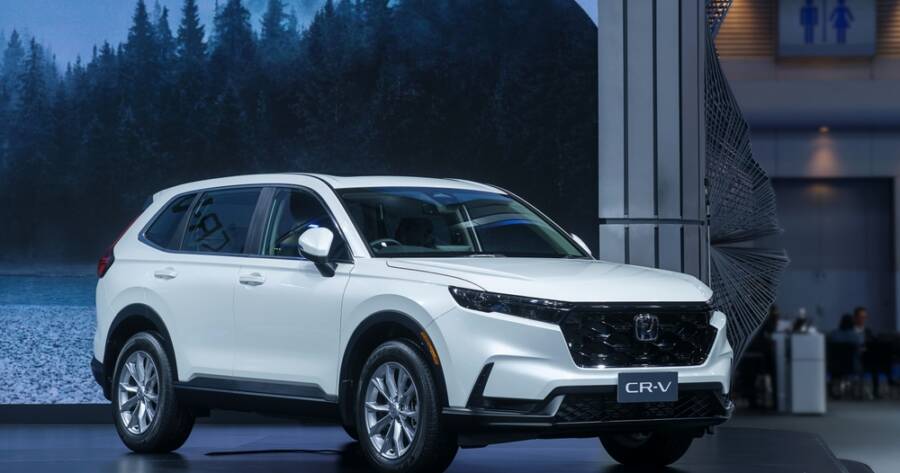
The 2027 Honda CR-V combines the qualities that matter most to families and everyday commuters: useful interior space, efficient powertrains, straightforward technology, and a broad selection of trims. Buyers can choose between a conventional turbocharged engine and several hybrid models, including the more rugged TrailSport Hybrid. Current pricing also gives shoppers clear steps from an affordable base model to a fully equipped hybrid.
Gas and Hybrid Powertrains Offer Different Strengths
The LX, EX, and EX-L trims use Honda’s 190-horsepower 1.5-liter turbocharged engine with a continuously variable transmission. Honda rates this configuration at up to 28 mpg city and 33 mpg highway, making it a practical choice for commuters who want strong fuel economy without moving to a hybrid (source).
The Sport Hybrid, TrailSport Hybrid, Sport-L Hybrid, and Sport Touring Hybrid instead use a 204-horsepower two-motor hybrid system. Honda lists fuel economy of up to 43 mpg city and 36 mpg highway for the hybrid powertrain, although ratings vary by trim and drivetrain. For example, the TrailSport Hybrid is rated at 38/33 mpg, while the Sport Touring Hybrid is rated at 40/34 mpg (source).
That range of choices gives commuters flexibility. Drivers focused primarily on highway use may find the turbo model perfectly adequate, while people who spend more time in city traffic can benefit from the hybrid’s stronger urban fuel economy.
Pricing Covers a Wide Range of Budgets
The 2027 CR-V starts at $31,520 for the LX. The EX begins at $33,550 and the EX-L at $35,800. Hybrid pricing starts at $36,030 for the Sport Hybrid, followed by $39,125 for the Sport-L Hybrid and $39,200 for the TrailSport Hybrid. The Sport Touring Hybrid tops the range at $42,950 (source).
That structure makes it easier to match the vehicle to a family’s actual priorities. Someone mainly concerned with price and commuting can stay near the lower end of the lineup, while buyers wanting leather seating, a power tailgate, upgraded audio, or all-wheel drive can move into higher trims.
Interior Space Works for Family Life
The CR-V’s usefulness goes beyond seating five people. Honda lists up to 106 cubic feet of passenger volume and as much as 76.5 cubic feet of maximum cargo space, giving families substantial room for groceries, luggage, sports equipment, or larger items when the rear seats are folded (source).
A reclining, 60/40 split-folding rear seatback is standard even on the LX, which makes it easier to balance passengers and cargo. Higher trims add conveniences such as heated front seats, dual-zone climate control, leather upholstery, and power tailgates (source).
Those features matter for more than road trips. A flexible rear seat and generous cargo area are equally useful for everyday school runs, shopping trips, strollers, work equipment, and other routine family demands.
Safety and Driver Assistance Come Standard
Honda Sensing is standard across the 2027 CR-V lineup. Even the LX includes the Collision Mitigation Braking System, Road Departure Mitigation System, Adaptive Cruise Control with Low-Speed Follow, Lane Keeping Assist System, Traffic Sign Recognition, and a rearview camera (source).
Moving up to the EX adds Blind Spot Information with Cross Traffic Monitor, while trims such as the EX-L add parking sensors and Low-Speed Braking Control. This tiered approach means buyers do not need to select the most expensive CR-V simply to obtain the core driver-assistance features.
For commuters, adaptive cruise control and lane assistance can reduce some of the workload associated with heavy traffic and long highway drives. Families may place greater value on collision mitigation, cross-traffic monitoring, and parking assistance in crowded neighborhoods or school parking lots.
Technology Is Designed Around Daily Use
Every 2027 CR-V includes a 9-inch touchscreen, wireless Apple CarPlay and Android Auto compatibility, and a wireless phone charger. Higher trims add features such as a 10.2-inch digital instrument cluster, Bose premium audio, and Google built-in on the Sport Touring Hybrid (source).
The TrailSport Hybrid brings a slightly different focus. It includes standard all-wheel drive, all-terrain tires, roof rails, and a heated steering wheel, making it better suited to families who regularly deal with snow, unpaved roads, or outdoor recreation (source).
Complimentary Maintenance Adds Early Ownership Value
Honda includes a maintenance program covering one year or 12,000 miles with the 2027 CR-V (source). That benefit can simplify the first year of ownership for commuters accumulating mileage quickly and for families trying to keep routine vehicle expenses predictable.
It should not be treated as proof that the CR-V will necessarily cost less to own over many years, but it does remove some scheduled-maintenance expense during the initial ownership period.
Why the 2027 CR-V Fits Families and Commuters
The strongest argument for the 2027 Honda CR-V is not one standout specification. It is the way its features work together. Families get flexible seating, substantial cargo capacity, useful safety technology, and available all-wheel drive. Commuters can choose between an efficient turbo engine and a hybrid system rated as high as 43 mpg in the city.
With seven trims ranging from the $31,520 LX to the $42,950 Sport Touring Hybrid, buyers can choose how much comfort, efficiency, technology, and capability they actually need (source). That balance makes the 2027 CR-V particularly well suited to households looking for one vehicle that can handle weekday commuting and family responsibilities without requiring major compromises.