

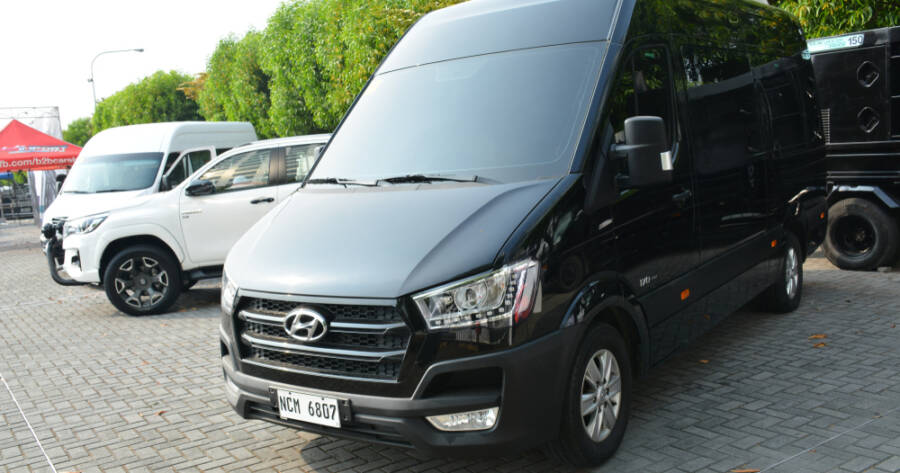
The Hyundai H350 combines the space and carrying ability expected from a serious commercial vehicle with styling and driver-focused features that give it a more polished character. Hyundai first introduced the H350 in 2014, yet its cargo capacity, diesel performance, safety technology, and multiple commercial configurations continues to turn heads.
A Commercial Van With a Distinctive Look
Large commercial vans are usually designed around function first, but Hyundai put considerable attention into the H350’s appearance. Its front end uses a large six-sided grille, while available projection headlamps and LED daytime running lights give the vehicle a recognizable Hyundai identity. The styling grew from Hyundai’s Fluidic Sculpture design philosophy, which the company describes as being inspired by nature (source).
The H350 is not, however, a newly developed model. Hyundai’s own vehicle history records its first appearance at the 2014 Hanover Motor Show and identifies it as the company’s first multipurpose light commercial vehicle built around a flexible platform (source). That history helps put the vehicle in context for today’s shoppers, particularly because specifications and availability can differ considerably between markets.
Cargo Space Is One of Its Biggest Strengths
The H350 was designed for businesses that need to move substantial loads without immediately stepping up to a larger truck. In long-wheelbase form, Hyundai lists up to 12.9 cubic meters of cargo volume and a load-floor length of 3,665 mm. That configuration has enough room for five Euro pallets. The short-wheelbase version provides up to 10.5 cubic meters and space for four Euro pallets (source).
Hyundai also designed the commercial platform for easier loading. Its engineering material describes doors wide enough for forklift access and rear doors capable of opening as much as 270 degrees, depending on configuration (source). For delivery companies, tradespeople, and other operators loading bulky equipment throughout the day, details like these can be as important as engine output.
Diesel Power Designed for Working Loads
Hyundai offers the H350 with a 2.5-liter CRDi diesel engine in different output levels. The higher-output Euro 6 version is rated at 125 kW and 422 Nm of torque, while another version produces 110 kW and 373 Nm. A six-speed manual transmission is designed to make use of the engine’s available torque while keeping the vehicle manageable in everyday driving (source).
The H350 can also handle substantial towing duties. Hyundai lists towing capacity of up to 3.5 tons and a gross combination weight of as much as 7 tons when the vehicle is equipped with the 170 PS engine and the specified 3.917 final-drive ratio (source). Because that rating depends on configuration, buyers should confirm the specification of the individual vehicle rather than assume every H350 can tow the maximum amount.
Safety Goes Beyond Basic Commercial-Van Equipment
The H350 incorporates several systems intended to address the particular challenges of driving a large commercial vehicle. Hyundai lists driver and passenger front airbags, four-wheel disc brakes, a disc-pad wear indicator, Roll Over Mitigation, and an Emergency Stop Signal among its safety equipment (source).
Roll Over Mitigation is designed to reduce rollover risk during sudden turning maneuvers, while the Emergency Stop Signal activates the hazard lights during heavy braking to warn following traffic. Hyundai also states that 75% of the H350’s chassis uses high-tensile steel, while anti-corrosion alloy steel is applied extensively throughout the body structure (source).
These features are particularly relevant for vans that may spend long days carrying tools, freight, or passengers under changing road and load conditions.
Built for More Than One Type of Business
Another reason the H350 stands out is the flexibility of its basic platform. Hyundai’s global commercial-vehicle range identifies van, bus, and chassis configurations, with variations in wheelbase, body height, and other dimensions (source).
That makes the platform useful for more than parcel delivery. A cargo van can serve trades or logistics companies, the bus configuration can support passenger transport, and the chassis version provides a base for specialized commercial bodies.
The driver environment also includes practical features such as a rear-view display system, available electrically folding mirrors, steering-wheel controls, storage areas, and an adjustable driver’s seat. These may sound less dramatic than towing figures, but comfort and visibility become important when a vehicle is used for hours at a time.
Why the Hyundai H350 Still Turns Heads
The Hyundai H350 is not officially sold in the United States, so American buyers would generally need to look to overseas markets rather than Hyundai’s U.S. dealer network. Its continuing appeal instead comes from a combination that remains useful for commercial work: up to 12.9 cubic meters of cargo room, five-pallet capacity, substantial diesel torque, configurable body styles, meaningful towing capability, and safety systems designed for a large working vehicle.
For businesses evaluating an H350 today, the most important step is checking the exact regional specification, model year, engine, and body configuration available. Hyundai notes that specifications can vary from one market to another. With the right configuration, however, the H350 offers a versatile commercial platform that balances heavy-duty practicality with a more refined approach to design and everyday usability.