

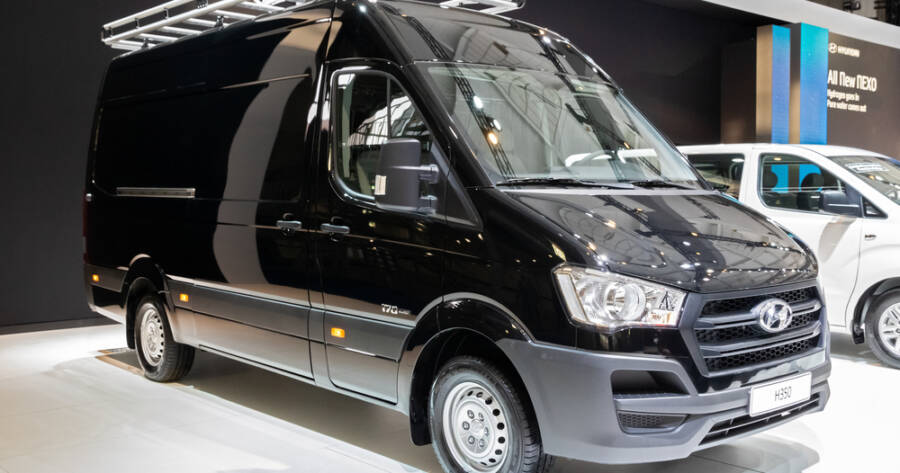
The Hyundai H350 has carved out a distinctive reputation in the light commercial vehicle segment, combining serious hauling capability with a driver-centered approach that few rivals manage to match. Here is a closer look at what sets this van apart.
A Vehicle Built With a Purpose
The Hyundai H350 is a full-size light commercial van that has been in production since 2014, first revealed to the public at the Hanover Motor Show that same year (source). Its very name carries practical meaning — the “350” designation directly references the vehicle’s gross vehicle weight rating of 3,500 kilograms, a figure that immediately signals how seriously Hyundai treated its load-bearing mission (source).
What makes the H350 especially notable in its history is that it represented Hyundai Motor Company’s first light commercial vehicle engineered from the ground up specifically for the European market (source). This wasn’t an adaptation of an existing platform — it was a deliberate, market-specific creation. The vehicle supports three distinct body configurations: cargo van, passenger bus, and flatbed truck, giving fleet operators and businesses a flexible foundation for a wide variety of working roles (source).
Engineering Priorities That Drive Real-World Value
During development, Hyundai’s LCV engineering team identified six pillars that would define the H350: efficiency, value, loading capacity, safety, reliability, and performance (source). These weren’t simply marketing talking points — each one shaped specific, measurable decisions in the van’s design and construction. The result is a vehicle that speaks directly to the daily demands of commercial operators who need dependable, cost-effective transportation that can handle both light and heavy-duty tasks without compromise.
On the powertrain side, the more powerful variant of the H350’s 2.5-liter turbocharged diesel engine delivers 167 horsepower and 311 pound-feet of torque, paired with a six-speed manual transmission (source). That output translates into meaningful real-world capability, particularly for operators who regularly load to capacity or navigate challenging terrain. The EURO 6-compliant version of the engine also brings a fuel efficiency improvement of up to 4.4% compared to the previous EURO 5 generation, thanks to a redesigned timing belt and reductions in internal friction (source).
Cargo and Towing Capabilities That Stand Out
At the heart of the H350’s appeal is its ability to move substantial loads efficiently. The cargo bay measures 3,780 by 1,795 by 1,955 millimeters and accommodates payloads reaching up to 1.4 tonnes (source). To put that space in practical terms, the van can fit as many as five standard European pallets in a single load, a benchmark that highlights just how competitive its loading capacity is in the segment (source).
Towing performance adds another dimension to the H350’s versatility. When equipped with the 170ps engine and the appropriate final gear ratio, the van achieves a class-leading towing capacity of 3.5 tonnes and a gross combination weight rating of up to 7 tonnes (source). For businesses that need to haul trailers, equipment, or additional cargo modules, this specification makes the H350 one of the most capable options in its class.
Passenger Flexibility and Seating Options
The H350 isn’t limited to cargo applications. In passenger configurations, the van accommodates between 14 and 17 passengers, making it a practical solution for shuttle services, airport transfers, and group transportation needs (source). Even in cargo form, the front cabin comfortably seats three people, ensuring that crew transportation and load movement can happen simultaneously without sacrificing space in either area (source). This dual-purpose flexibility is a key reason why fleet managers across multiple industries have found the H350 to be a compelling investment.
Safety Features Designed for Working Conditions
Commercial vehicles often operate in demanding, high-stress driving environments, and Hyundai built the H350 with that reality in mind. The van’s body structure incorporates advanced high-strength steel combined with precision chassis engineering, resulting in a bodyshell that Hyundai describes as offering “class-leading crashworthiness” (source).
Active safety technology rounds out the protection package. The H350 features a Lane Departure Warning System, front airbags for both driver and front passenger, four-wheel disc brakes, Roll Over Mitigation technology, and an Emergency Stop Signal system (source). These systems work together to reduce the risk of accidents during long hauls or urban deliveries, providing an added layer of protection for drivers, passengers, and the cargo onboard. For fleet operators managing risk and insurance considerations, this safety suite represents genuine added value.
A Driver-Focused Cabin Experience
Beyond the mechanical and structural specifications, the H350 was developed with the driver’s daily experience as a priority. Spending extended hours behind the wheel of a commercial van is physically demanding, and Hyundai’s engineers structured the cabin to address that challenge directly. Ergonomic seating, intuitive controls, and a layout that reduces driver fatigue all contribute to a workspace that keeps the operator comfortable and alert during long shifts.
The combination of these qualities — spacious load area, strong towing numbers, multi-body versatility, and a well-considered cab environment — is what has made the H350 a compelling choice not just in Europe but in markets across the globe, including South Korea and Vietnam where it is sold under the Solati name (source).
Why You Should Learn More About the Hyundai H350 Today
The Hyundai H350 brings together cargo capacity, towing strength, passenger flexibility, and a well-equipped safety suite into a single, purpose-built platform. Whether the need is for heavy freight movement, group transportation, or a versatile fleet workhorse, the H350 delivers on multiple fronts. Its engineering pedigree — built around six core priorities with a market-specific focus — reflects a van designed not just to compete, but to stand out. For businesses evaluating their next commercial vehicle purchase, exploring the H350’s full range of specifications, configurations, and capabilities offers a clearer picture of what modern light commercial vehicle engineering can achieve at this level of the market.