

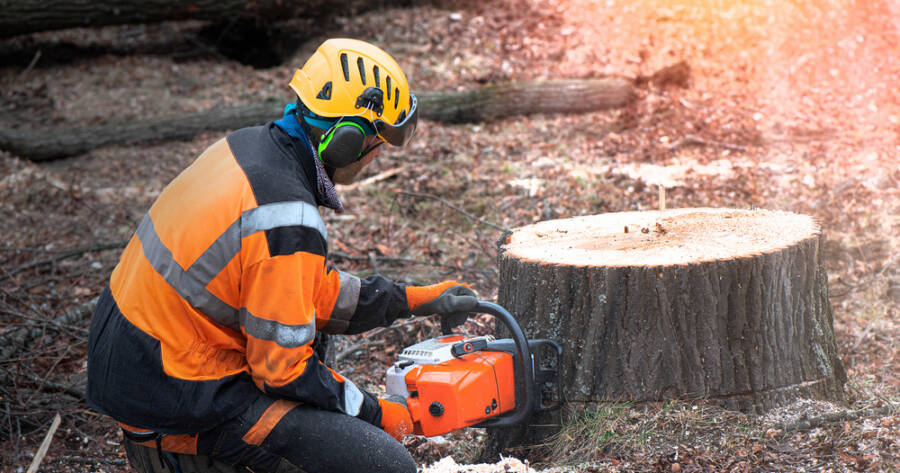
A tree stump can quickly become more than an eyesore, especially when it interferes with mowing, landscaping, or plans for new planting. Homeowners generally have three practical ways to deal with one: grinding it mechanically, speeding decomposition with chemical treatment, or digging it out by hand. Each method differs considerably in cost, effort, speed, and how much of the stump remains underground.
Why Tree Stumps Are Worth Removing
A leftover stump does more than clutter a yard. It can attract wood-decaying fungi and insects, interfere with lawn maintenance, and make replanting in that area difficult. Depending on the tree species, an untreated stump may persist in the ground for well over a decade before it fully breaks down on its own. Homeowners who want to reclaim that space sooner will benefit from understanding the most practical removal options available and what each one demands in terms of time, effort, and cost.
Method One: Stump Grinding
Among all the available approaches, stump grinding stands out as the fastest and most efficient option. Arborists use large machines that chew through the stump and the major lateral roots, typically grinding down 8 to 12 inches below the surface within just a few hours (source). The process is well-suited to stumps of virtually any diameter, and because it is mechanized, the physical demand on the property owner is minimal.
However, stump grinding does come with one important caveat. The wood shavings produced during the process significantly alter soil structure, moisture retention, and nutrient levels in the area, creating challenging conditions for anything new planted there (source). As those wood fragments break down in the soil, they can tie up available nitrogen, which makes it harder to establish new turf or garden plants where the tree once stood (source). Property owners who plan to replant soon after grinding should account for this by adding nitrogen amendments before seeding or planting.
Method Two: Chemical Treatment
For those who prefer a hands-off approach, chemical stump treatment offers a low-labor alternative. Potassium nitrate, also known as saltpeter, is a commonly used active ingredient that draws moisture out of the wood to accelerate drying and decay (source). The method typically involves drilling holes into the stump, filling them with the chemical compound, and then allowing the material to break down over time.
The trade-off is speed. Chemical treatment only accelerates the decomposition process by roughly 25 percent compared to doing nothing at all (source). For homeowners dealing with a large stump or a species known for dense, slow-rotting wood, this method may still require years of patience. It works best as an option for stumps in low-traffic areas where there is no urgency to reclaim the ground quickly.
Method Three: Manual Digging
Digging out a stump by hand is the most physically demanding of the three primary methods, but it remains a viable choice for smaller stumps with a diameter under 12 inches. The process involves cutting a trench around the stump, typically one to two feet deep, and then severing the lateral roots with a saw before leveraging the stump out of the ground (source). No specialized equipment is required beyond basic digging tools and a hand or reciprocating saw.
The main advantage of manual removal is that it extracts the root mass entirely, leaving cleaner soil behind compared to grinding. That can make immediate replanting more straightforward, since there is no wood debris decomposing underground. The significant downside is the labor involved, which scales considerably with root depth and stump size. For larger stumps, the physical effort makes this method impractical without professional assistance or heavy equipment.
Accelerating Natural Decay as a Complement
Some homeowners choose to enhance the natural breakdown process rather than remove the stump outright. Research from the University of Georgia suggests that boosting surface area, improving soil aeration, maintaining moisture, and increasing nitrogen availability can speed up stump degradation by as much as 50 percent (source). For a stump roughly 10 inches in diameter, applying around half a pound of nitrogen per year in three separate applications can meaningfully fuel the microbial activity responsible for breaking down the wood (source).
This approach pairs well with chemical treatment or can be used on its own for stumps in garden beds or wooded areas where appearance is less of a concern. It requires minimal cost and effort but demands patience, as even an accelerated timeline may span several years depending on soil conditions and the tree species involved (source).
Choosing the Right Method for Each Situation
No single method suits every stump removal scenario. Stump grinding delivers the quickest results and handles large stumps effectively, but it leaves behind debris that complicates replanting. Chemical treatment is low effort but slow, making it better suited for situations where time is not a factor. Manual digging is thorough and leaves cleaner soil, but the labor involved limits its practicality to smaller stumps. Homeowners who weigh timeline, stump size, and future landscaping plans before committing to a method are far more likely to achieve the outcome they want.
Why You Should Learn More About Tree Stump Removal Today
Tree stump removal is not a one-size-fits-all task. Each method carries distinct advantages that depend on the stump’s size, the property owner’s timeline, and what they intend to do with the space afterward. Grinding is fast but disrupts soil chemistry. Chemical treatment is passive but slow. Manual digging is thorough but physically demanding.
Understanding these differences helps property owners make informed decisions rather than costly mistakes. Consulting a certified arborist can also provide valuable, site-specific insight before committing to any single approach. The more a homeowner understands about the process, the better equipped they are to restore their yard efficiently and prepare it for whatever comes next.