

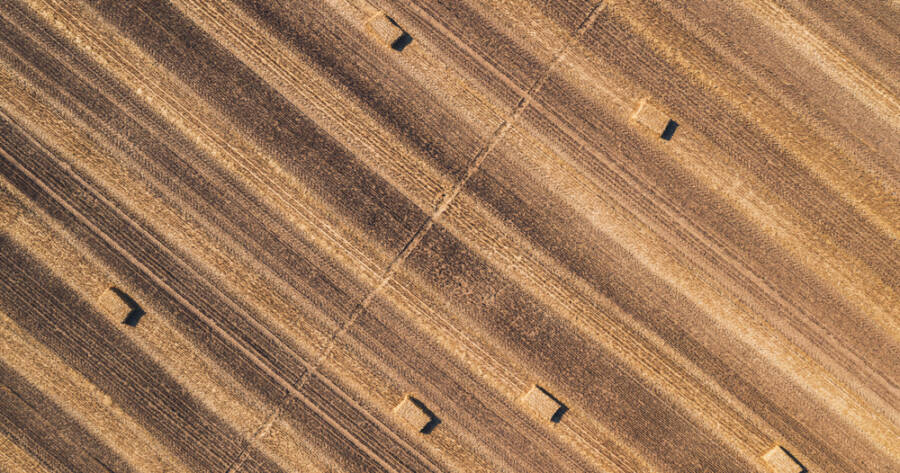
Hay fields can seem ordinary from the roadside, but a drone reveals a completely different landscape. Mowing lines become sweeping patterns, scattered bales turn into geometric shapes, and subtle variations in grass color form unexpected compositions. By removing familiar ground-level perspective, aerial photography can transform one of America’s most practical agricultural landscapes into images that resemble carefully planned abstract art.
Why Hay Fields Work So Well From Above
Hay covers an enormous amount of American farmland. Approximately 48.5 million acres were harvested in the United States in 2024, with production varying considerably according to climate, soil, precipitation, and irrigation conditions (source). That scale gives photographers a tremendous variety of landscapes to explore, from broad plains to fields surrounded by hills, woods, or irrigation systems.
What makes hay especially interesting visually is the way farming creates order across the land. Cutting and drying produce swaths and windrows that trace long paths through a field. Later, baling adds another layer of structure. Round bales may appear as scattered circles from directly overhead, while rectangular bales create harder edges and more obvious repetition.
From ground level, these elements primarily communicate agricultural work. From above, their practical purpose becomes less obvious, allowing shape, spacing, and repetition to dominate the image.
Mowing Lines Become Graphic Patterns
One of the strongest visual elements in a hay field is the pattern left behind by mowing equipment. Straight passes can divide the land into stripes, while curved fields produce arcs that follow hills, property boundaries, or terrain.
Aerial photography is particularly effective at exposing patterns that are difficult to recognize from the ground. Lines, shapes, repetition, negative space, and rhythm can become the primary subjects once the horizon and other familiar reference points disappear (source).
Hay fields naturally provide all of these elements. A photographer flying directly overhead might frame alternating rows of cut and uncut grass as parallel bands. From a slight angle, those same rows can create depth and lead the viewer’s eye toward bales, trees, or another contrasting feature.
The result does not necessarily look like a traditional landscape photograph. In the strongest images, viewers may notice the design before they recognize the subject as farmland.
Hay Bales Create Natural Focal Points
Bales introduce another layer of abstraction because they interrupt otherwise repetitive fields. A single round bale can become the focal point in a largely empty composition, while dozens spread across a field create rhythm through repetition.
Their placement also produces useful negative space. Wide areas of cut grass surrounding isolated bales can make an image feel deliberately minimalist even though the arrangement was created for agricultural reasons rather than artistic ones.
Shadows add another opportunity. When the sun sits lower in the sky, round or rectangular bales cast long shapes across the field. Those shadows can exaggerate spacing and make comparatively small objects feel much more prominent within the frame. This is one reason the same hay field can produce very different photographs depending on when the drone flies.
Height Changes the Entire Composition
Altitude is one of the most important creative decisions in abstract drone photography. Flying too low can preserve so much recognizable detail that the photograph still reads primarily as a conventional rural scene. Flying much higher can simplify individual elements into lines, blocks, and repeated shapes.
Abstract aerial photography depends heavily on finding the right balance between recognizable detail and visual simplification. Height and camera angle determine whether a landscape appears dimensional or begins to resemble a flat arrangement of shapes and colors (source).
Hay fields give photographers room to experiment with that transition. A lower view might emphasize the cylindrical form of individual bales, while a straight-down photograph from greater altitude can turn those same bales into simple circles scattered across bands of gold and green.
Light Changes Texture, Color, and Mood
The time of day can radically alter how a field appears. Early and late sunlight emphasizes texture through shadows, making stubble, windrows, tire tracks, and bales more dimensional. Midday light can create a flatter appearance that emphasizes color and pattern instead.
That flatter light is not necessarily a disadvantage. In abstract aerial photography, midday conditions can help colors and repeated structures become more prominent because long shadows are reduced (source).
Season matters as well. Agricultural landscapes can change dramatically depending on cultivation stage, with fields producing different colors and patterns throughout the year (source). A freshly cut field may contain bright straw-colored rows, while later conditions can produce softer browns, greens, or muted earth tones.
Turning Working Farmland Into Visual Art
The appeal of aerial hay-field photography comes from the contrast between function and appearance. Every line, track, bale, and cleared section exists because someone is producing livestock feed, yet those same features can form a sophisticated composition when viewed from above.
Photographers can emphasize symmetry, repetition, contrast, isolation, or movement simply by changing altitude, camera angle, and framing. Little or no artificial manipulation is necessary because the underlying geometry already exists in the landscape.
A field that looks repetitive from a road can therefore become surprisingly complex from the air. Drone photography does not create those patterns. It reveals an arrangement that was already present but difficult to perceive from ordinary human height.
Seeing Hay Fields Differently
Drone photography turns hay fields into abstract art by stripping away the familiar perspective through which people normally understand them. Rows become lines, bales become shapes, shadows create contrast, and variations in vegetation become blocks of color.
With millions of acres of hay harvested across the United States, photographers have an enormous and continually changing canvas available to them. The artistic opportunity lies in recognizing that agriculture already creates patterns across the land. A drone simply provides the viewpoint needed to see them.