

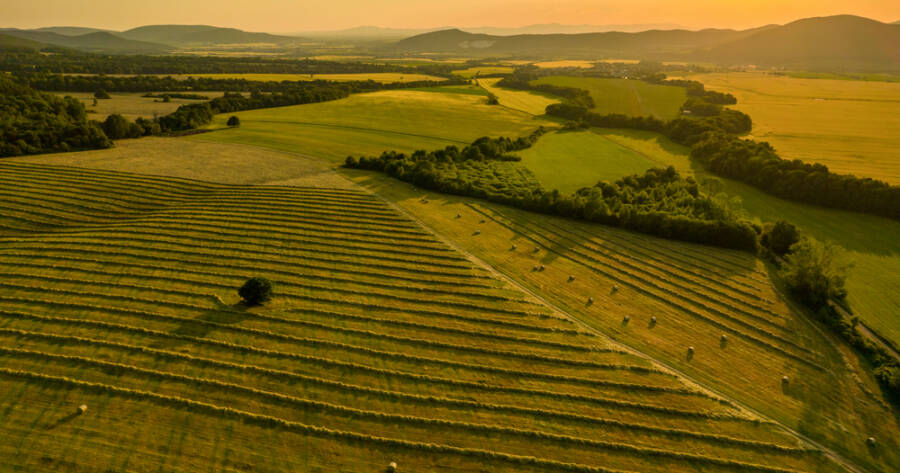
A hay field can look purely practical from the roadside, but a drone changes the view completely. Rows, bales, tractor lines, shadows, and shifting colors begin to form patterns that resemble paintings or graphic design. By changing altitude and perspective, photographers can turn an ordinary agricultural landscape into something unexpectedly geometric, textured, and visually striking.
The Hidden Art Inside Every Hay Field
Hay fields cover an enormous portion of the American countryside. Roughly 48.5 million acres of hay were harvested across the United States in 2024, a figure that underscores just how deeply embedded this crop is in the nation’s agricultural identity (source). Alfalfa alone accounts for approximately one-third of total hay acreage, and production patterns shift significantly from region to region depending on climate, soil conditions, and irrigation access (source). These are working fields, engineered for efficiency and yield. Yet when a drone rises above them, something unexpected happens: all of that practical agricultural engineering transforms into visual art.
The bales themselves are central to this transformation. Whether round, square, or large square in format, each bale type creates a distinct shape against the shorn field surface (source). From directly overhead, a row of round bales reads as a sequence of perfect circles casting soft shadows. Large square bales arrange themselves into grid-like formations that feel more architectural than agricultural. The field between them, striped by harvest lines and varying in color depending on moisture and cutting stage, serves as a canvas that changes with every season and every pass of equipment.
How Drone Photography Reveals What Eyes Cannot See
Drone photography has fundamentally changed what landscape photographers can capture. Aerial shots provide a bird’s-eye view, revealing patterns, shapes, and colors that are not visible from the ground (source). For hay fields specifically, this shift in altitude reframes everything. The compression of depth that occurs when a lens points straight down flattens the scene into something closer to a painting or a graphic design than a conventional photograph. Pointing the camera straight down minimizes many of the depth cues seen from the ground, allowing the field’s shapes, lines, and repeated forms to become the dominant visual elements (source).
An overhead viewpoint can reveal subtle color shifts, repeated textures, and large-scale patterns that are difficult to recognize from ground level (source). In a hay field context, this means the subtle color banding left by different cutting passes, the variation in field tone where alfalfa meets grass hay, or the long geometric shadows that bales cast during early morning and late afternoon light. Photographers who seek out these locations often develop a heightened appreciation for patterns embedded in nature, including crop fields and the orderly rhythms of agricultural management (source).
Techniques That Turn Fields Into Compositions
Successfully translating a hay field into abstract aerial art requires deliberate compositional decisions. One of the most effective techniques involves using contrast between different field sections. Visual contrast can make an aerial composition more dynamic. Differences in texture, brightness, or field color can divide the frame into distinct sections and give the image a stronger sense of structure (source). A freshly cut section next to one that is still standing creates exactly this kind of visual tension.
Lines also play a critical role. The furrows and harvest tracks that machinery leaves behind become strong compositional elements when viewed from altitude. Tracks, furrows, and other marks left across the field can form striking repeated patterns when viewed from high above (source). A photographer who positions the drone at the right height can use these lines as leading elements that draw the eye across the frame, organizing the image around rhythm rather than subject matter alone.
Timing matters as well. The angle of sunlight at golden hour exaggerates texture and shadow, making the surface of a baled field appear almost three-dimensional even in a flat overhead shot. Shooting directly above a field during midday creates a different effect — high contrast, minimal shadow, and a graphic quality that suits a more minimalist aesthetic. Each lighting condition yields a different version of the same field, and experienced aerial photographers often return to the same location across seasons and times of day to document that range.
Practical considerations shape the process, too. Drones typically carry between 20 and 30 minutes of flight time per battery charge, which makes pre-planning essential (source). Identifying the most promising compositional angles before launching, and mapping out a sequence of shots in advance, allows photographers to capture the full potential of a location without wasting time aloft. Hay fields, which change dramatically in appearance between cutting cycles and across growing seasons, reward photographers who plan repeat visits rather than relying on a single session.
Why Regional Variety Expands Creative Possibilities
Because hay production varies widely across the United States (shaped by local climate, soil type, precipitation levels, and irrigation availability), different regions offer distinctly different visual material (source). The irrigated alfalfa fields of the arid Southwest produce intensely geometric patterns of vivid green against pale, dry surrounding land. The rolling mixed-grass hay fields of the Midwest offer more organic, undulating compositions. Pacific Northwest fields sit within forested backdrops that introduce entirely different color relationships and scale references.
This geographic diversity means that drone photographers working with hay fields as their subject matter are never working with a single visual vocabulary. Each region presents its own palette, its own textures, and its own relationship between the cultivated field and the surrounding environment. A top-down view can transform a familiar landscape into an abstract work of art, making the ordinary extraordinary through the simple act of changing altitude (source).
Why You Should Learn More About Hay Field Drone Photography Today
Hay fields are among the most overlooked subjects in landscape photography, yet they hold remarkable visual potential for anyone willing to look from a different angle. The interplay between agricultural geometry, natural color variation, and the abstract qualities that altitude reveals makes these working landscapes a compelling subject for drone photographers at any experience level.
As the art form continues to grow in sophistication, hay fields across the country offer an endlessly renewable canvas. One that shifts with every season, every harvest, and every change in the light. Understanding both the agricultural rhythms that shape these fields and the photographic techniques that best capture them gives photographers a meaningful edge in producing images that feel genuinely original.