

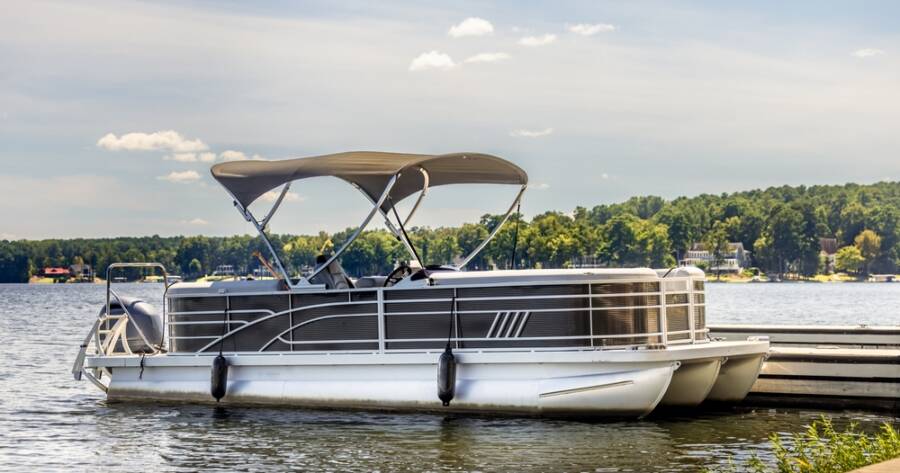
For families, anglers, and casual boaters who prioritize comfort over speed, small pontoon boats offer a uniquely rewarding on-the-water experience. Their stable, open-deck design makes calm water recreation accessible to nearly anyone—from first-time boaters to seasoned lake regulars.
What Makes a Pontoon Boat Different
A pontoon boat is built on a flat deck supported by two or three hollow metal tubes running along the underside of the vessel. Those tubes—called pontoons—are responsible for the boat’s buoyancy and its trademark stability (source). Unlike traditional hulled boats that cut through the water at an angle, a pontoon sits level on the surface, creating a wide, open platform that feels more like a floating patio than a conventional watercraft.
This structural approach directly shapes who buys these boats and how they use them. The broad, flat deck allows for chairs, tables, coolers, fishing gear, and even small furniture arrangements—all of which would be impractical on a narrow-hulled vessel. That versatility is a defining characteristic of the pontoon category, and it becomes even more pronounced in smaller models designed specifically for intimate outings and tight waterways.
Size, Range, and What to Expect
Pontoon boats span a surprisingly wide range of lengths, from compact models under 16 feet to larger vessels stretching beyond 25 feet (source). Smaller pontoons in the lower end of that spectrum are particularly well-suited to narrow lakes, shallow rivers, and modest bays where maneuverability matters. Their reduced footprint makes docking, launching, and storage far more manageable for everyday boaters who don’t have access to large marina slips or expansive trailering setups.
Despite their modest dimensions, small pontoon boats can be configured with a meaningful range of amenities. Entry-level models keep things practical with basic seating and minimal hardware, while more feature-rich versions add padded loungers, onboard storage, fishing rod holders, and upgraded upholstery (source). Buyers can match the level of outfitting to their intended use without paying for features they won’t use on the water.
Power usually comes from an outboard motor mounted at the stern, a setup that keeps the main deck clear and makes engine access straightforward (source). Outboard motors on smaller pontoons tend to run quietly and require relatively minimal upkeep compared to inboard engine systems, which adds to the appeal for casual recreational users who want more time on the water and less time in the maintenance bay.
Stability and Safety on Calm Water
One of the most frequently cited advantages of pontoon boats is their inherent stability. The twin- or triple-tube flotation system keeps the vessel balanced and level even when passengers shift around the deck (source). For families with young children, older passengers, or individuals who feel uneasy on rocking boats, this stability translates directly into a safer, more relaxed experience.
Pontoon boats perform best in calm environments—lakes, protected bays, and slow-moving rivers where wave action is minimal (source). In those settings, the flat deck and steady ride allow passengers to move around freely, which matters for activities like fishing, swimming off the side, or simply relaxing with a meal. The design is not intended for rough offshore conditions or heavy chop, but within its intended environment, few recreational vessels match its practical comfort.
Ease of Handling for New and Experienced Boaters
Pontoon boats have earned a strong reputation for being beginner-accessible. Their stability in the water and straightforward handling characteristics make them far less intimidating than performance boats or sailboats (source). First-time operators generally find that learning to steer, dock, and navigate a small pontoon boat requires significantly less trial and error than mastering other hull types.
That said, experienced boaters also gravitate toward small pontoons when the goal is relaxation rather than performance. Hosting a group of friends for a day on a calm lake, taking family members on a leisurely afternoon cruise, or anchoring in a quiet cove for fishing are all activities that reward a steady, comfortable platform over raw speed. The pontoon’s wide deck and gentle ride serve those purposes well regardless of how many years a person has spent behind the helm.
The combination of easy handling and genuine comfort is also what makes pontoon boats “wildly popular for lake boating,” according to Discover Boating (source). Their broad adoption across skill levels reflects a design that genuinely delivers on its promises in real-world recreational use.
Who Benefits Most from a Small Pontoon
Small pontoon boats attract a diverse group of buyers. Families with children benefit from the open, fenced deck layout that keeps young passengers safe while allowing adults to supervise with ease. Anglers appreciate the stable casting platform and the ability to configure the deck with rod holders and live wells. Social boaters value the seating capacity and the relaxed atmosphere that a flat, open deck naturally provides.
Because these vessels are “spacious and comfortable, ideal for families and gatherings,” they function as a social anchor for a day on the water rather than just a method of transport (source). That social dimension is a meaningful part of why small pontoons have maintained such consistent appeal across different buyer profiles and age groups.
Why You Should Learn More About Small Pontoon Boats
Small pontoon boats represent a practical and enjoyable entry point into recreational boating for a wide range of people. Their flat-deck design, metal-tube flotation system, and calm-water focus combine to produce a vessel that is genuinely stable, comfortable, and accessible. From narrow inland lakes to quiet river stretches, these compact boats deliver a relaxed on-the-water experience that larger or faster vessels often cannot replicate. Whether the priority is family outings, casual fishing, or simply spending time afloat with friends, small pontoon boats offer a dependable platform built around the needs of everyday recreational use. Understanding the full range of sizes, configurations, and features available helps prospective buyers make an informed decision that suits both their waterway and their lifestyle.