

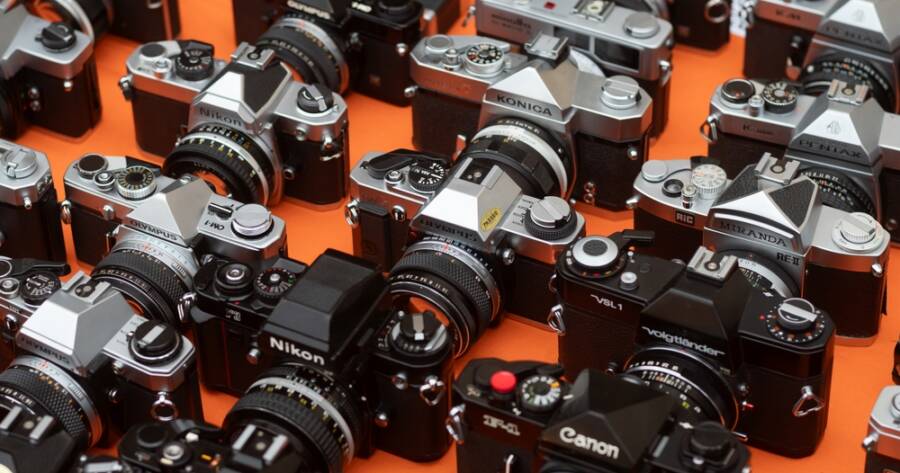
Vintage film cameras appeal to collectors for more than nostalgia. Some models combine lasting usability with influential design, scarce variations, famous histories, or unusually strong secondary-market demand. Leica rangefinders, classic Rolleiflex twin-lens cameras, Hasselblad medium-format systems, and premium compact models continue to attract attention, but condition and rarity can dramatically change what any example is worth.
Leica M3 and M6 Remain Collector Favorites
Leica’s film M cameras remain among the clearest examples of vintage cameras with an active collector market. The M3, introduced in 1954, combines historical importance with a design that photographers can still use today. Current secondary-market data shows regular M3 sales continuing in substantial numbers, while clean bodies, early examples, special finishes, and unusual serial numbers can bring sizable premiums. Standard M3 bodies have recently averaged well above $1,000, while exceptional examples can move into an entirely different price category (source).
The M6 is another particularly desirable Leica because it pairs the traditional M-system shooting experience with a built-in light meter. In June 2026, secondary-market tracking showed non-TTL M6 bodies averaging around $3,100, with special finishes and collector versions selling for considerably more (source). Rare Leica provenance can push values even higher: one historically significant M3 sold for approximately $3.76 million at Leitz Photographica Auction, demonstrating how dramatically rarity and history can affect collector value (source).
Rolleiflex 2.8F and 3.5F Appeal to Medium-Format Collectors
Rolleiflex twin-lens reflex cameras remain desirable because they combine unmistakable design with a medium-format system that can still be used with 120 film. Models such as the Rolleiflex 2.8F and 3.5F are particularly recognizable, with their waist-level viewfinders, square 6×6 negatives, and high-quality Planar or Xenotar lenses. Recent Leitz auction results show ordinary examples of the 2.8F and 3.5F selling for approximately $2,000 to $2,150, demonstrating continued interest beyond purely decorative collecting (source).
Special versions can command considerably more. A Rolleiflex 2.8F Aurum, a gold-plated edition produced in limited numbers, recently sold for approximately $4,000, while prototypes and other unusual variations have also attracted premiums (source). For collectors, the attraction lies in the combination of mechanical craftsmanship, distinctive appearance, usable film format, and the possibility of finding scarce editions that stand apart from standard production cameras.
Hasselblad 500-Series Cameras Combine Prestige and Usability
Hasselblad’s 500-series cameras occupy another important part of the collector market. The 500C and 500C/M are modular medium-format cameras built around interchangeable lenses, film backs, and viewfinders, giving them lasting appeal to photographers as well as collectors. Standard 500C/M outfits continue to appear at specialist auctions, with condition, included lenses, accessories, and originality having a major impact on price. A 500C/M Anniversary 500 Classic recently sold for approximately $1,600 at Leitz Photographica Auction (source).
Rare accessories or important provenance can raise values sharply. One 500C/M outfit accompanied by an uncommon original Sabre gun stock sold for approximately $7,400, far above the price of many ordinary examples (source). Hasselblad’s connection to professional photography and the space program further strengthens the brand’s historical appeal, but collectors should distinguish between common working cameras and genuinely scarce versions when evaluating value.
Contax T2 Shows the Appeal of Premium Film Compacts
Not every collectible film camera is a fully mechanical rangefinder or medium-format system. The Contax T2 has become a sought-after premium compact because it combines a titanium body, Carl Zeiss Sonnar lens, autofocus, and point-and-shoot convenience in a small package. Current used listings show working examples capable of reaching well above $1,000 depending on condition, while damaged or nonworking bodies trade for much less (source).
Special editions add another collector dimension. The Contax T2 60 Years Limited Edition, distinguished by its gold finish, is identified by used-camera dealer MPB as a collector-oriented version and periodically sells out of available stock (source). The T2 illustrates how modern collector demand is not limited to the oldest cameras. Design reputation, premium materials, lens quality, cultural visibility, and limited-production variations can all make a comparatively recent film camera desirable.
What Actually Drives Collector Value Today
Rarity remains one of the clearest value drivers. Prototypes, early serial numbers, limited editions, unusual finishes, factory variations, and cameras associated with significant owners or events can sell for many times the price of ordinary examples. Recent Leica and Rolleiflex auction results repeatedly show that scarcity and provenance can have a greater effect on value than the basic model name alone (source).
Condition and usability matter as well. Collectors generally look closely at original finishes, functioning shutters and meters, clean lenses, matching accessories, boxes, service history, and evidence of modification. Cameras using readily available formats such as 35mm or 120 film also attract working photographers, expanding the potential buyer pool beyond display-only collectors. A common camera in exceptional condition can therefore be more desirable than a rarer example that has been heavily altered, damaged, or poorly maintained.
Why Certain Vintage Film Cameras Still Stand Out
The strongest vintage-camera collectibles usually offer more than a famous badge. Leica M cameras combine historical importance with an unusually active secondary market, Rolleiflex models pair distinctive engineering with medium-format usability, Hasselblad systems carry professional prestige, and premium compacts such as the Contax T2 appeal to a newer generation of film enthusiasts.
Collectors considering any vintage camera should look beyond broad price guides and examine the exact model, production variation, condition, accessories, provenance, and recent comparable sales. The difference between an ordinary user camera and an exceptional collector piece can be enormous. Understanding what makes one example special is ultimately more valuable than simply knowing which brand names are popular.