

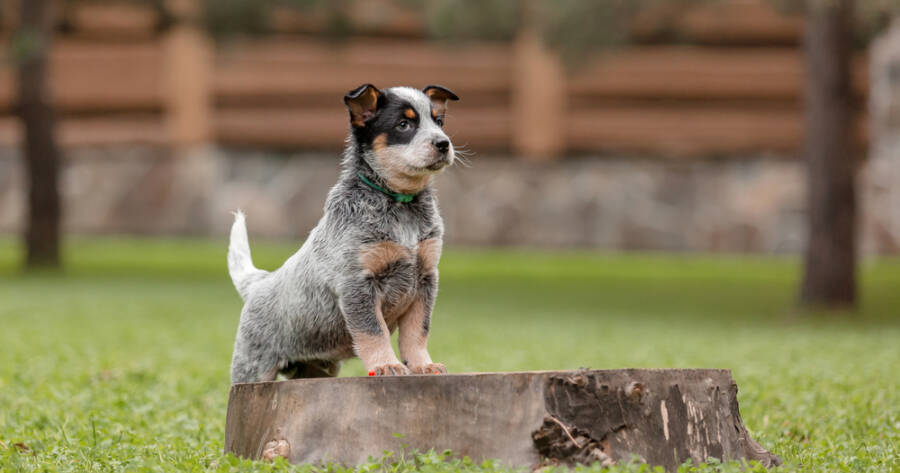
Australian Cattle Dog puppies look surprisingly different at four weeks than they do as newborns. Born mostly white, they begin developing the blue or red roaning that eventually gives the breed its unmistakable coat. At the same time, their eyes are open, tiny teeth are emerging, and their personalities are beginning to show, making four weeks a fascinating stage to watch.
What Makes the Australian Cattle Dog a Distinctive Breed
The Australian Cattle Dog stands out for its compact, muscular build, working history, and distinctive blue or red coat patterns. Compact, hard-muscled, and built for endurance, the breed stands between 17 and 20 inches at the shoulder and carries a body shaped by centuries of working Australia’s rugged terrain (source). Its closest wild relative is the Australian Dingo, a connection that runs deeper than appearance alone and contributes to the breed’s sharp intelligence and intense drive (source).
What truly sets the Australian Cattle Dog apart from nearly every other breed is its coat. Recognized color registrations include Blue, Blue Mottled, Blue Speckled, Red Speckled, and Red Mottled, with optional markings in Tan, Red, and Black and Tan (source). These patterns do not appear at birth, which is what makes observing a puppy in its earliest weeks such an extraordinary experience. The coat’s development is not simply a color change — it is a biological process unfolding in real time.
Born White: The Surprising Truth About Cattle Dog Puppies at Birth
A newborn Australian Cattle Dog does not look like the boldly patterned adult it will become. Every puppy in the litter arrives in the world with a white coat, which can catch first-time observers completely off guard (source). Some puppies carry visible markings on the head or tail from the very start (black patches on puppies that will develop into blue dogs, and red patches on those that will become red speckle dogs), but others are born entirely solid white with no immediate indication of what pattern lies ahead (source).
This white birth coat is not a defect or an anomaly. It is a defining characteristic of the breed, driven by specific genetics. The distinctive blue or red roaning pattern that makes these dogs so visually remarkable develops gradually in the white areas of the coat during the first weeks after birth (source). The process is quiet and incremental at first, but by the four-week mark, something remarkable becomes visible.
What a Four-Week-Old Australian Cattle Dog Puppy Actually Looks Like
By around four weeks, an Australian Cattle Dog puppy may already be showing much more of the blue or red coloring that was faint or absent at birth. The breed’s characteristic appearance comes from colored hairs mixing with white hairs across the coat, creating blue roaning or red speckling. How quickly the pattern becomes visible varies from puppy to puppy, and the coat will continue developing as the dog grows (source).
Four-week-old puppies are also becoming noticeably more active. Their eyes are open, they can walk, and they may begin barking, wagging their tails, and interacting more with their mother and littermates (source). Baby teeth also begin emerging during the early weeks of puppyhood. At this age, the combination of developing movement, behavior, and coat color makes the puppy look increasingly different from the mostly white newborn it was only a few weeks earlier.
Understanding the Genetics Behind the Pattern
One common misconception about the Australian Cattle Dog’s coat is that it results from the merle gene, the same gene responsible for the dappled patterns seen in breeds like the Australian Shepherd. This is inaccurate. The Australian Cattle Dog’s pattern is not considered merle. According to the Australian Cattle Dog Club of America, its ticking and roaning appear to be governed by genes associated with the T locus rather than the M locus responsible for merle patterning (source). Understanding this distinction helps explain how the Australian Cattle Dog’s distinctive coat develops and prevents confusion with merle-patterned breeds.
The genetics also explain why the coat color cannot be predicted with certainty at birth in a fully white puppy. The eventual pattern is encoded but not yet expressed, and the four-week window is where that expression begins to emerge in a way that even a non-expert eye can start to detect. It is one of the few moments in dog breeding where genetics becomes directly and dramatically observable in real time.
Why the Four-Week Stage Matters for Enthusiasts and Breeders
For anyone involved in evaluating Australian Cattle Dog litters, whether breeders, potential owners, or breed enthusiasts, the four-week mark carries real significance. It is the first point at which the coat pattern offers meaningful visual information, making it a critical observation window. A puppy showing early, well-distributed roaning at this stage gives early insight into how its adult coat may develop, though the full pattern continues to fill in over subsequent months.
The breed’s recognized coat variations, including Blue Mottled, Blue Speckled, Red Mottled, and Red Speckled, each have their own visual character, and seeing those differences begin to emerge in a litter at four weeks is part of what makes the Australian Cattle Dog so compelling to those who study the breed seriously. Watching the coat develop during the first few weeks offers an interesting look at how the Australian Cattle Dog’s characteristic coloring gradually takes shape.
Why You Should Learn More About Cattle Dog Puppies
At four weeks, an Australian Cattle Dog puppy may already look dramatically different from the mostly white newborn it was just a few weeks earlier. Blue or red coloring becomes easier to see as the coat develops, while the puppy is also learning to walk, interact, vocalize, and explore its surroundings.
The adult coat is still taking shape at this age, so four weeks offers an early glimpse rather than a finished picture. Understanding how the breed’s coloring and physical development progress can help owners and enthusiasts know what to expect as a young Australian Cattle Dog continues to grow.