

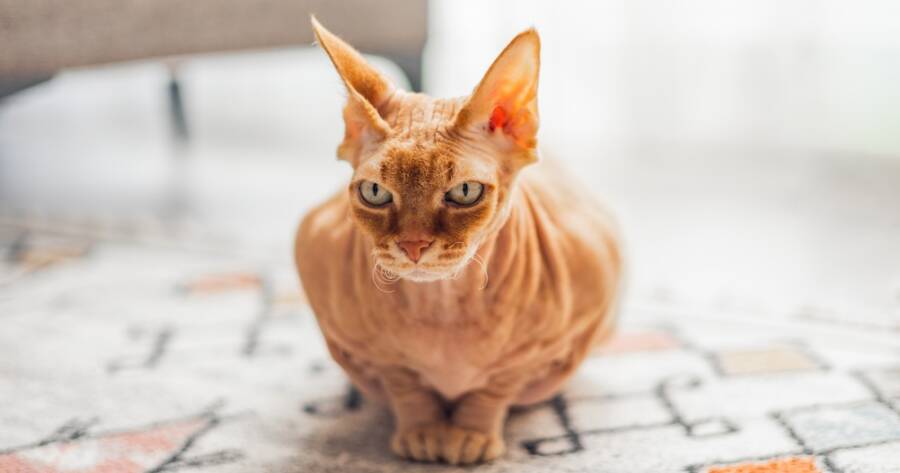
The Donskoy is one of the most visually striking cat breeds in existence, and at eight weeks old, they’re already showcasing the distinctive traits that define them. Understanding early development helps owners recognize what is normal for the remarkable Donskoy breed.
What Makes the Donskoy Breed Unique
The Donskoy’s unusual coat is linked to a dominant hair-loss gene. Some kittens are born completely hairless, while others begin life with fur and gradually lose it as they mature (source). This characteristic distinguishes the breed visually from an early age and helps explain why Donskoy kittens can look noticeably different from one another.
Wrinkled skin is another defining feature of the breed. The folds are especially noticeable around the cheeks, chin, forehead, neck, chest, and base of the tail, although wrinkles can also extend along the body and legs (source). Combined with the Donskoy’s sparse or absent coat, these pronounced folds give even young cats their distinctive appearance.
The Four Coat Types and How They Appear in Young Kittens
Donskoys can have four recognized coat types: Rubber Bald, Flocked, Velour, and Brush. Rubber Bald kittens are born without fur and remain bald throughout their lives. Flocked Donskoys have a very fine, soft covering that can eventually disappear, leaving the cat completely hairless (source).
Velour kittens are born with a bald area on the top of the head and a coat that gradually disappears as they grow. Some hair may remain on the face, legs, or tail, although Velour Donskoys can ultimately become completely bald. Brush Donskoys retain considerably more hair, which may be soft, wavy, bristly, or wiry, often alongside hairless patches (source).
These coat differences mean an eight-week-old Donskoy does not necessarily have the completely bare appearance many people associate with the breed. Depending on its coat type, a young kitten may already be hairless or may still carry varying amounts and textures of fur that can change considerably as it matures.
Physical and Behavioral Development at Eight Weeks
Regardless of coat type, all Donskoy kittens reach important developmental milestones by eight weeks of age. At this stage, a healthy kitten should weigh approximately two pounds, which is a standard benchmark that also marks the point when kittens are considered ready for spaying or neutering (source). Reaching this weight reflects proper nutrition and development since birth.
Eight-week-old kittens are fully weaned from their mother’s milk, eating solid food independently and managing litter box use without assistance (source). For Donskoy kittens specifically, good nutrition at this age is especially important since their bare or minimally covered skin means they expend more energy regulating body temperature than coated breeds do.
Behaviorally, eight-week-old kittens explore their environment with confidence, moving away from their mother to investigate independently. They can jump, play, and are developing more refined motor coordination (source). Donskoy kittens at this age are typically curious and sociable, traits that carry into adulthood.
It is also worth noting that the growth rate slows considerably around this time. Rather than the rapid weight doubling seen in earlier weeks, kittens at eight weeks begin building muscle tone and strength at a steadier pace (source). Owners should expect consistent but gradual progress from this point forward rather than dramatic size changes week to week.
Caring for a Young Donskoy’s Skin
Because Donskoy kittens lack the protective layer of fur that most breeds have, their skin is exposed directly to the environment from a very young age. The wrinkled skin folds that characterize the breed can accumulate oils and debris more readily than smooth skin, making gentle, regular cleaning an important part of early care. Owners should begin establishing grooming routines soon after bringing an eight-week-old Donskoy home so the kitten becomes accustomed to being handled and cleaned.
Temperature sensitivity is another consideration. Without a full coat, these kittens rely more heavily on their environment and their own metabolism to stay warm. Ensuring that a young Donskoy has access to warm resting areas and is not exposed to drafts or cold surfaces helps support healthy development during these early weeks.
Why You Should Learn More About the Donskoy Kitten
The Donskoy breed offers a genuinely unique ownership experience, and the first eight weeks of a kitten’s life set the tone for everything that follows. From the four distinct coat types shaped by a dominant gene to the physical milestones every eight-week-old kitten should meet, understanding this breed’s early development allows owners to provide better care and recognize what healthy growth actually looks like.
The Donskoy’s wrinkled skin, varied coat presentations, and sociable temperament make it one of the most rewarding breeds to raise and observe. Learning about the breed’s genetics, developmental stages, and care requirements builds a stronger foundation for a long, healthy relationship between owner and cat.