

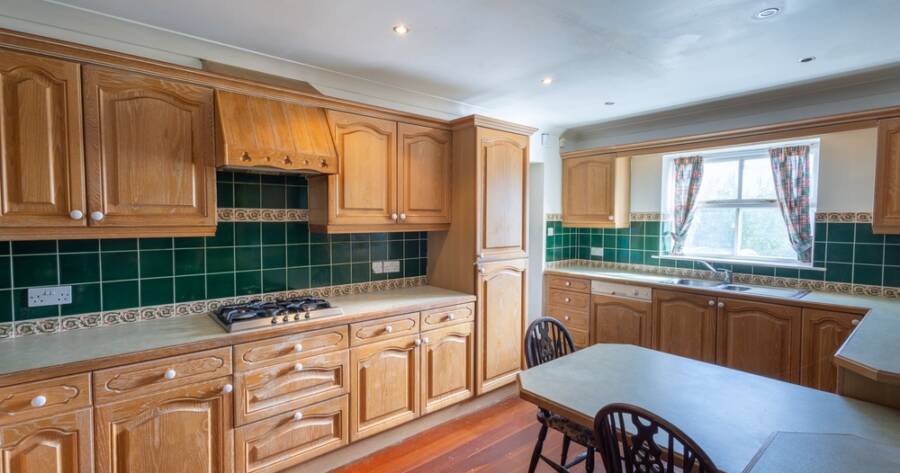
A 1990s oak kitchen may look outdated, but replacing all the cabinets is rarely the only way to modernize it. Simple changes, such as updating hardware, refinishing wood surfaces, painting cabinet doors, or replacing countertops, can make a noticeable difference. With thoughtful planning and budget-friendly improvements, homeowners can refresh their kitchens while preserving existing cabinetry.
What Made 1990s Oak Kitchens So Recognizable
Walk into any home built or renovated during the 1990s and the kitchen often tells the story immediately. Raised panel doors with cathedral or arched profiles, exposed hinges, gold-toned hardware, laminate countertops, and diagonal backsplash tiles arranged in a 4×4 pattern were all hallmarks of the era (source). The oak itself brought a warm, honey-toned grain that was beloved at the time but now reads as unmistakably dated in most design contexts.
The challenge for homeowners is that these kitchens were built to last. The bones are often solid, the cabinets sturdy, and the layout functional. Tearing everything out is not only expensive but unnecessary. What truly ages the space is rarely the structure itself but rather the stylistic details layered on top of it.
The Door Profile Problem and How to Solve It
Among all the elements that make oak kitchens look stuck in the past, the door style stands out as the most impactful offender. Cathedral and arched raised-panel doors are identified as “the #1 reason oak kitchens look dated,” and replacing them with slab or slim Shaker profiles at a relatively modest per-door cost is considered one of the most transformative changes a homeowner can make (source). Even when cabinets are painted, an ornate door profile can still undermine the modern effect.
Swapping to a flat-front slab or a clean Shaker door instantly shifts the visual language of the kitchen toward something contemporary. Combined with updated hardware, this single change can make a space feel like it belongs to a different decade entirely.
Painting Oak Cabinets: The Right Way to Do It
Painting oak cabinets is one of the most popular update strategies, but it requires a specific technical approach to succeed. Oak contains natural tannins that bleed through standard latex primers and create a yellow, blotchy finish over time. Professional painters rely on Zinsser B-I-N shellac-based primer as the standard solution to prevent this tannin bleed before applying topcoats (source). Skipping this step is one of the most common reasons painted cabinet projects fail within a year or two.
Color selection also matters significantly. A two-tone approach has emerged as a strong trend heading into 2026, with upper cabinets painted in white, sage green, or navy while the lower cabinets retain their natural oak finish. This method reduces the visual heaviness of a fully painted kitchen while preserving the warmth the wood naturally provides (source).
Hardware, Backsplash, and the Details That Shift Everything
Hardware replacement delivers a high visual return for a relatively modest investment. The key is to move away from gold-toned pieces with decorative swirls and ornate curves, opting instead for streamlined pulls and knobs in matte black, brushed nickel, or unlacquered brass. Updating wall color to a modern light taupe, replacing older light fixtures, and installing a 3×6 subway tile backsplash are all moves that push a 1990s kitchen decisively into contemporary territory (source).
Countertops also play a critical role. Black granite is described as “hands down the easiest to work with when modernizing a kitchen,” while white quartz or a marble-look laminate pairs especially well with oak cabinets that are being kept in their natural finish (source). For those on a tight budget, sourcing stone remnants from local fabricators or scrap yards can dramatically reduce the countertop cost without sacrificing the look.
A Real-World Budget Makeover That Proves It Works
The budget required to modernize a 1990s oak kitchen varies widely depending on the scope of the project. A hardware-only refresh can be accomplished for a few hundred dollars, while a mid-range update incorporating a new backsplash, staining, and hardware replacement typically runs into the low thousands. A more comprehensive transformation covering multiple elements can reach higher, but still remains well below the cost of replacing cabinets entirely, which can extend into the tens of thousands (source).
One documented case study illustrates what is possible on a tight budget. A homeowner updated their entire 1990s kitchen for under $4,000 by painting the cabinets, hand-painting ceramic tile to replicate the appearance of Zellige tile, replacing all the hardware, and sourcing a marble piece from a local scrap yard for just $100 (source). The result was a space that bore little resemblance to its former self, achieved through creativity and prioritization rather than a full gut renovation.
Why You Should Learn More About Kitchen Cabinet Makeovers
A 1990s oak kitchen is not a design problem without a solution. From door profile replacements and cabinet painting to backsplash swaps and countertop upgrades, the path from dated to modern is well-established and achievable at a range of price points.
Prioritizing the updates with the greatest visual impact, like door profiles and hardware, allows homeowners to stretch their renovation dollars further. Whether someone chooses a single focused change or a multi-step transformation, understanding the full landscape of options helps ensure that every dollar spent moves the kitchen meaningfully forward.