

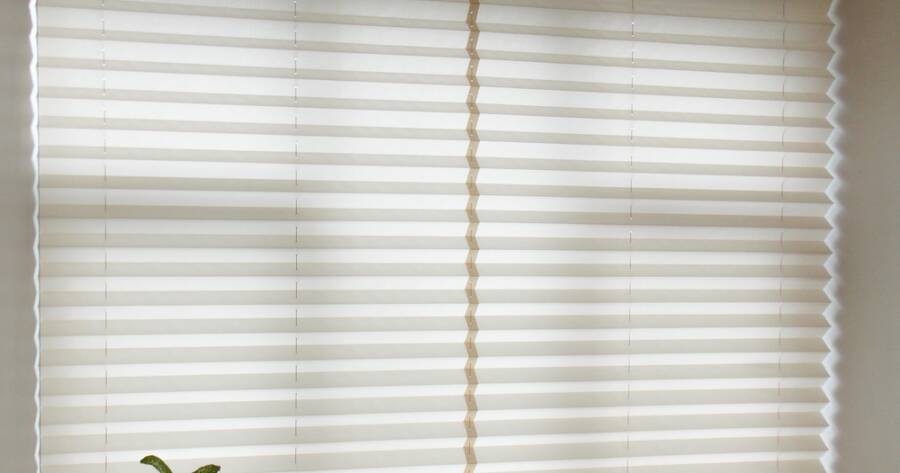
Vertical blinds remain practical for wide patio doors, but they are no longer the only option. Homeowners can now choose from panel tracks, cellular shades, roller shades, privacy sheers, shutters, and drapery, each offering a different balance of style, insulation, privacy, and light control. Comparing those alternatives can make it easier to find a solution that suits both the room and the door.
Why Vertical Blinds Fall Short
Vertical blinds were once considered the practical solution for wide patio and sliding glass door openings, but their shortcomings have become increasingly hard to ignore. One of the most common complaints is poor light control. This is because vertical blinds often contain gaps between each slat as well as on each end of the entire panel, letting in unwanted light and reducing privacy (source). For bedrooms, media rooms, or any space requiring true darkness, this is a significant drawback.
Beyond performance, there is the matter of aesthetics. The dangling slats of vertical blinds tend to clash with modern interior design sensibilities. They rattle in air conditioning drafts, tangle easily, and individual slats can crack or warp over time. When replacement becomes necessary, costs can add up. For these reasons, many homeowners are exploring treatments that combine clean looks with real functionality.
Panel Track Blinds: The Minimalist Upgrade
Among the most popular modern replacements for vertical blinds, panel track blinds stand out for their clean, architectural appearance. These treatments consist of large fabric panels that glide along a track system, typically four to six panels cover a standard sliding glass door, and their oversized panels create a more minimalist overall look compared to vertical blinds (source).
Panel track blinds are particularly well suited to contemporary, Scandinavian, and Japandi-influenced interiors, making them a natural fit for the design preferences many American homeowners currently favor (source). Functionally, they move laterally along their track and stack neatly to one side, operating in the same direction as the sliding door itself — an intuitive and space-efficient motion (source). They are available in a wide range of materials and patterns, giving homeowners considerable flexibility in how they coordinate with existing décor.
One consideration worth noting is cost. Unlike vertical blinds, where a single broken slat can be swapped out inexpensively, panel track systems can involve higher upfront investment and potentially greater repair costs if a panel becomes damaged (source). For many homeowners, that trade-off is well worth the visual and functional upgrade.
Cellular Shades for Energy Efficiency
Homeowners in climates with harsh winters or sweltering summers often prioritize insulation alongside aesthetics. Cellular shades address both needs. Their distinctive honeycomb construction traps air within individual pockets, forming an additional insulating barrier at the glass — a feature that makes them especially practical for patio and sliding glass doors exposed to temperature extremes (source).
The energy-saving benefits of cellular shades are well documented. Their layered structure helps moderate interior temperatures, reducing dependence on heating and cooling systems (source). Beyond thermal performance, they also filter light softly and offer a clean, tailored appearance that suits a wide variety of interior styles. For a patio door that faces direct afternoon sun, cellular shades can make a measurable difference in comfort.
Roller Shades, Privacy Sheers, and Natural Materials
For homeowners who want simplicity and a clear sightline, roller shades deliver excellent light control with a sleek, uncluttered profile. When raised, they roll up neatly and leave the door opening completely unobstructed (source). Available in blackout, light-filtering, and solar screen fabrics, roller shades can be customized to meet the specific light control needs of any room.
Privacy sheers offer a more layered approach. Products like Hunter Douglas’s Luminette® Privacy Sheers pair soft fabric vanes with a sheer facing, allowing homeowners to rotate the vanes open to enjoy diffused daylight and preserve the outdoor view, or close them for nighttime privacy — all within a single treatment (source). This dual-function design is especially appealing for living rooms and family rooms where both atmosphere and privacy matter throughout the day.
Woven wood shades bring warmth and organic texture to the equation. Crafted from natural woods, bamboo, reeds, and grasses, they are available in both horizontal and vertical orientations and complement a broad range of home styles — from coastal and Mediterranean interiors to more traditional settings (source). For homeowners who want their patio door treatment to feel like a design statement rather than an afterthought, woven wood shades offer a distinctive, nature-inspired alternative.
Shutters and Drapery as Permanent Solutions
For those seeking a long-term, high-impact solution, shutters represent one of the most substantial investments in patio door window treatments. Mounted on a bi-fold or bypass track, shutter panels fold or slide away from the door opening entirely, providing unobstructed access when desired (source). Because shutters are considered permanent fixtures rather than window dressings, they can actually increase the resale value of a home (source). Their crisp, architectural look works well in traditional, transitional, and even contemporary interiors.
Panel track blinds are widely considered the most stylish and practical alternative to vertical blinds for sliding glass doors (source), but drapery also earns its place in the conversation. Floor-to-ceiling drapery panels soften the hard lines of a sliding glass door, add acoustic insulation, and lend a sense of height and elegance to any room. Paired with a quality hardware track, drapery can be opened and closed smoothly, making it a functional choice as well as a decorative one.
Why You Should Learn More About Patio Door Window Treatments Today
Choosing the right window treatment for a patio or sliding glass door is about far more than covering glass. The right solution manages sunlight, improves energy efficiency, enhances privacy, and elevates the visual character of a room.
Whether a homeowner prioritizes the thermal performance of cellular shades, the modern clean lines of panel track blinds, the organic warmth of woven wood, or the lasting value of shutters, there is a well-designed option to meet every need. Vertical blinds served their purpose for decades, but the alternatives available today offer measurable improvements in every category that matters: performance, style, and long-term value.