

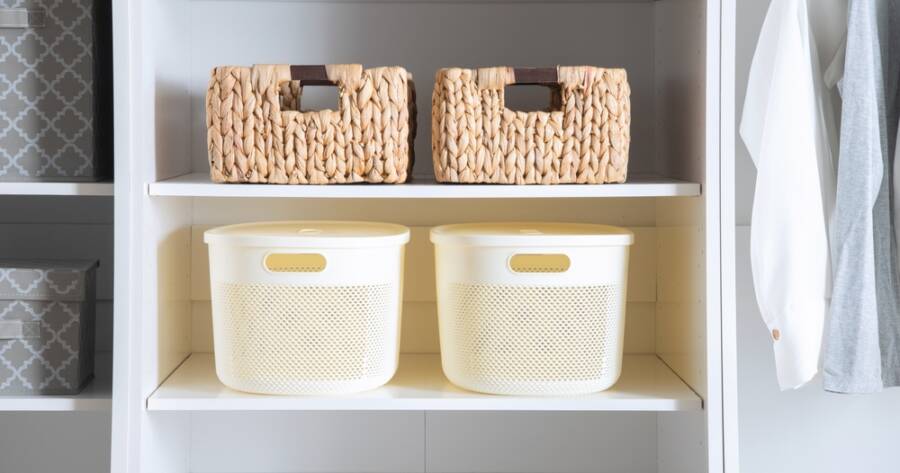
Plastic bins are practical, but they are not the only way to keep a home organized. Wood, bamboo, fabric, metal, woven baskets, and built-in storage can offer different combinations of durability, flexibility, and style. Choosing the right alternative depends on what needs to be stored, where it will go, and whether appearance, portability, or long-term organization matters most.
The Problem With Plastic Storage Bins
For decades, plastic bins have been the default answer to clutter. They’re cheap, they stack, and they come in every size imaginable. But over time, their shortcomings become hard to overlook. The reality is plastic storage doesn’t age well. Surfaces grow cloudy, materials turn brittle, and the bins themselves often retain odors from whatever was stored in them previously (source). What begins as a budget-friendly solution frequently ends up in a landfill, replaced by another round of the same disposable products.
Beyond durability concerns, plastic bins rarely add anything to a room’s appearance. They tend to look temporary, even when they’ve been sitting in the same corner for years. Homeowners who invest in their interiors often find that stacks of mismatched plastic containers work against the aesthetic they’ve worked hard to create. That disconnect is part of why so many people are actively seeking out alternatives that serve both practical and visual goals.
Bamboo and Wood: Natural Materials That Last
Bamboo has emerged as one of the most popular storage materials for eco-conscious homeowners. As a plant that regenerates quickly, bamboo offers a renewable source for bins, crates, and boxes that plastic simply cannot match in sustainability (source). Wooden crates crafted from reclaimed or recycled timber carry a similar appeal, reducing the demand for freshly harvested materials while delivering a warm, natural texture that fits into a wide range of interior styles (source).
Both bamboo and wood storage options tend to be considerably more durable than their plastic counterparts. Unlike bins that crack under weight or warp in heat, solid natural materials hold their shape over years of regular use. Whether arranged on open shelving or tucked into a closet, these materials carry a visual quality that actually improves a room rather than detracting from it.
Fabric Bins: Flexible, Washable, and Versatile
Fabric bins offer a level of flexibility that rigid containers struggle to match. Available across an enormous range of sizes and design patterns, they adapt to storage needs throughout the home, from nurseries and living rooms to linen closets and home offices (source). One especially practical feature is washability, which makes fabric bins far easier to maintain over time than plastic alternatives that discolor or develop residue.
Soft-sided fabric containers also have a natural advantage when it comes to fitting into awkward or irregular spaces. They compress slightly when not fully loaded and conform more forgivingly to shelving configurations. For households that need to reorganize frequently — growing families, apartment dwellers, or people who move often — fabric bins provide real adaptability without sacrificing neatness.
Metal and Wire Baskets: Industrial Style Meets Durability
Metal and wire baskets represent another smart departure from plastic. Constructed from materials like stainless steel, iron, or copper, these containers bring both strength and a distinctive aesthetic to any space (source). Their open construction makes contents easy to identify at a glance, eliminating the need to dig through opaque bins to find what’s needed. The industrial or rustic character they carry works especially well in kitchens, bathrooms, and home offices where open storage is both practical and visually intentional.
Metal containers don’t just look good; they’re built to outlast most plastic alternatives by a significant margin. Heavy-gauge wire or solid metal won’t crack, stain, or absorb odors, making them a reliable long-term investment for high-use areas of the home.
Wicker and Rattan: Handcrafted Warmth for Any Room
Wicker and rattan storage bins have been a design staple for good reason. Handwoven from natural materials including seagrass, water hyacinth, or rattan, these containers are lightweight and easy to move around the home (source). Their organic texture and neutral tones allow them to blend naturally into almost any décor, whether a space leans coastal, bohemian, Scandinavian, or traditional.
The handcrafted nature of wicker and rattan bins also means each piece carries a sense of individuality that mass-produced plastic containers can never replicate. For homeowners who prioritize warmth and character in their interiors, these materials offer a storage solution that doubles as a decorative element rather than something to hide away.
Custom Storage Furniture: A Long-Term Solution
While individual bins and baskets solve piece-by-piece clutter, custom storage furniture addresses organization at a structural level. Modular wardrobes, built-in closet systems, and tailored entertainment centers are designed to integrate directly into a home’s architecture, eliminating the need for freestanding containers altogether (source). Rather than adding more objects to solve a clutter problem, this approach folds the solution into the design of the home itself.
Custom closet systems in particular offer a meaningful advantage over any type of bin-based storage. Adjustable shelving and modular components take full advantage of vertical space in ways that stacked plastic bins simply cannot achieve (source). Quality storage furniture built from solid materials is designed to serve a household for decades, making it a fundamentally different investment than disposable containers that need periodic replacement (source).
Why You Should Learn More About Modern Storage Alternatives Today
The shift away from plastic storage bins reflects something deeper than a passing design trend. It represents a growing awareness that what fills a home should be both purposeful and enduring.
Natural materials like bamboo, rattan, and reclaimed wood bring warmth and sustainability to everyday organization. Fabric bins deliver flexibility for households that evolve. Metal and wire containers offer lasting durability without sacrificing style. And custom storage furniture transforms entire rooms into efficient, beautiful spaces built to last. Every household has different needs, but the common thread among these alternatives is that they outperform plastic on nearly every measure, including longevity, aesthetics, and environmental impact. Exploring these options is a practical step toward a more considered, intentional home.