

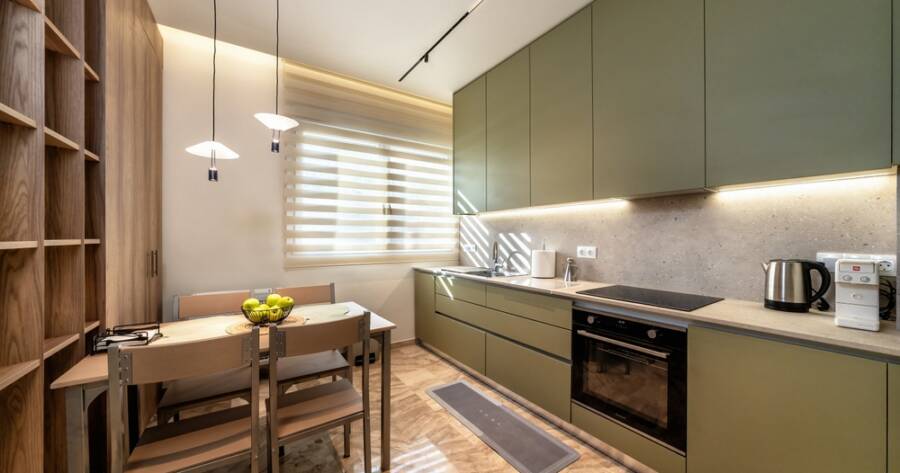
Sage green is not disappearing from kitchens, but it is facing much stronger competition in 2026. Designers are leaning toward deeper greens, warmer browns, saturated blues, natural wood, and other colors with more depth and personality. For homeowners who still love an earthy palette but want something fresher, the next wave of kitchen color feels richer and more layered.
Why Sage Green Is Losing Its Grip on Kitchen Design
For several years, sage green dominated kitchen cabinetry and became a near-universal choice for homeowners seeking something warmer than white but softer than bold color. Its appeal made sense: it reads as approachable, sits comfortably alongside natural materials, and photographs well. However, widespread popularity has a way of dulling even the most appealing trend, and sage green has reached that tipping point.
Design professionals now describe the color as occupying an uncertain middle ground. “Sage is neither colorful nor neutral, instead arriving someplace in the middle that leaves us aptly lukewarm,” notes one perspective circulating among kitchen design circles (source). Homeowners who once found it refreshing are now seeking cabinet colors with stronger personality and more staying power.
Dark Olive Green: The Sophisticated Heir to Sage
Among the colors taking the lead, dark olive green has emerged as the front-runner favored by professional designers. The hue shares sage green’s earthy DNA but delivers considerably more depth and warmth. Sophie Pringle, Founder of Pringle and Pringle, describes the shift directly: “Sage green has been incredibly popular for many years, but we’re now seeing clients wanting colors with a little more depth and character. Dark olive feels richer, earthier and more sophisticated” (source).
One major advantage driving its rise is that dark olive still functions as a neutral in practical terms. Unlike bold statement colors that can feel like a commitment homeowners may regret, olive works across a broad range of kitchen styles and finishes (source). Hannah Yeo, Senior Manager of Color Marketing at Benjamin Moore, explains that dark olive pairs effortlessly with natural wood, stone surfaces, brass hardware, and brushed nickel, helping pull a kitchen’s many elements together into a unified space (source).
For homeowners drawn to a greener direction but wanting something more current, deeper forest and brown-green tones are also gaining traction. These richer hues complement materials like concrete countertops and pine or bamboo accents in ways that sage simply cannot match (source).
Warm Browns, Taupes, and Off-Whites Are Taking Over
Not every homeowner moving away from sage green is heading toward a deeper green alternative. A significant number of kitchen redesigns are gravitating toward warm neutral territory. Creative designer Jayne Everett of Naked Kitchens has observed growing client interest in off-white, taupe, and mocha tones for cabinetry, often layered together rather than used as a single dominant shade (source).
This shift mirrors a broader appetite for kitchens that feel cozy and grounded. Hannah Yeo at Benjamin Moore connects the movement to a desire for spaces that reflect personal style through natural textures and earthy palettes: “From warm browns to deep tans, homeowners are embracing warmer and moodier colors… warm wood tones and nuanced hues are timeless, comfortable, and thoughtful” (source). These tones reward careful material selection and tend to age gracefully alongside evolving interior choices.
Wood Cabinetry and Bold Blues Making a Strong Return
Two additional directions are drawing substantial attention from both designers and homeowners. Natural wood cabinetry has staged a notable comeback, moving kitchens away from the painted-cabinet era that defined the last decade. Wood tones pair particularly well with large stainless steel appliances, producing an atmosphere that feels simultaneously warm and contemporary rather than sterile or overly traditional (source).
Bold, saturated blues represent another strong contender. Interior designer Bethany Adams draws a clear distinction between the navy trend of a few years ago and what is emerging now: “Blue is making a comeback in kitchens in a big way… While navy had a moment a few years ago, the blues of the future are more saturated and less neutral” (source). These deeper, more vivid blues offer the visual drama that many homeowners are now craving after years of muted, understated palettes.
Mustard Yellow as an Unexpected Accent Choice
For those who want genuine color energy in a kitchen without straying into territory that feels risky, mustard yellow has become a recommended alternative. Like sage green, it carries warmth and an earthy quality, but it has not yet reached the saturation point where familiarity breeds fatigue (source). Mustard works particularly well as a cabinet accent or a choice for a kitchen island, allowing homeowners to introduce personality without overwhelming an entire space.
This kind of strategic color placement aligns with how designers are increasingly approaching kitchens overall: rather than committing every surface to a single trending hue, layering complementary colors and materials creates depth that holds up over time. Dark olive on perimeter cabinetry, warm wood on an island, and brass or matte black hardware, for example, can produce a kitchen that feels both current and enduring.
Why You Should Learn More About Kitchen Color Trends Today
Kitchen color choices carry long-term design and lifestyle consequences. Dark olive green, warm taupes, saturated blues, natural wood, and mustard yellow are all proving themselves as more enduring replacements for sage green, each offering richer character and greater versatility.
Designers consistently emphasize that the best cabinet color is one that feels timeless rather than trend-driven, pairing well with a variety of materials and evolving effortlessly as a home’s other elements change. Staying informed about where kitchen design is heading helps homeowners make confident, lasting decisions that reflect both personal style and sound design thinking.