

Traditional above-ground pools dominated American backyards for decades, but shifting homeowner priorities around space, cost, and year-round value are driving a quiet revolution in outdoor living. Two compelling alternatives have emerged as the leading replacements.
Why Above-Ground Pools Are Falling Out of Favor
Above-ground pools once represented an affordable path to backyard recreation, but their limitations have become harder to overlook. They demand significant open yard space, operate only during warm months, and require consistent chemical maintenance throughout the swim season. As homeowners increasingly seek multipurpose outdoor investments that deliver value beyond a few summer months, the traditional above-ground pool simply no longer checks every box. Two newer alternatives — swim spas and plunge pools — have stepped in to address those gaps in ways the conventional round or oval above-ground unit never could.
Swim Spas: Year-Round Functionality in a Compact Footprint
Swim spas have carved out a major share of the backyard water feature market by combining the exercise benefits of a lap pool with the relaxation features of a hot tub, all within a structure that fits comfortably in smaller outdoor spaces. Their typical length ranges from 12 to 19 feet, and the total space requirement — including surrounding clearance — generally falls between 400 and 800 square feet, making them a viable option for yards where a full pool would never fit (source).
One of the most significant advantages swim spas hold over above-ground pools is their ability to operate throughout the year. Heating a swim spa adds only a modest amount to monthly energy costs compared to what traditional pool heating demands during cooler seasons (source). That seasonal flexibility turns what would otherwise be a few-months-per-year amenity into something homeowners actively use in winter, spring, and fall.
Water cleanliness is another area where swim spas outperform conventional pools. Their filtration systems cycle through the full water volume roughly every 15 minutes, whereas a traditional pool might take anywhere from 12 to 18 hours to complete a single filtration pass (source). The result is consistently cleaner water that demands fewer chemicals to maintain — an appealing factor for families with young children or individuals sensitive to heavy chlorine exposure.
From a financial standpoint, swim spas also present a compelling case. Their upfront purchase price runs substantially lower than inground pools, and their operating costs reflect a leaner, more efficient design. For homeowners who want the look and feel of a premium aquatic feature without the premium price tag of a full inground installation, swim spas occupy an attractive middle ground.
Plunge Pools: Small-Scale Luxury With Big Design Appeal
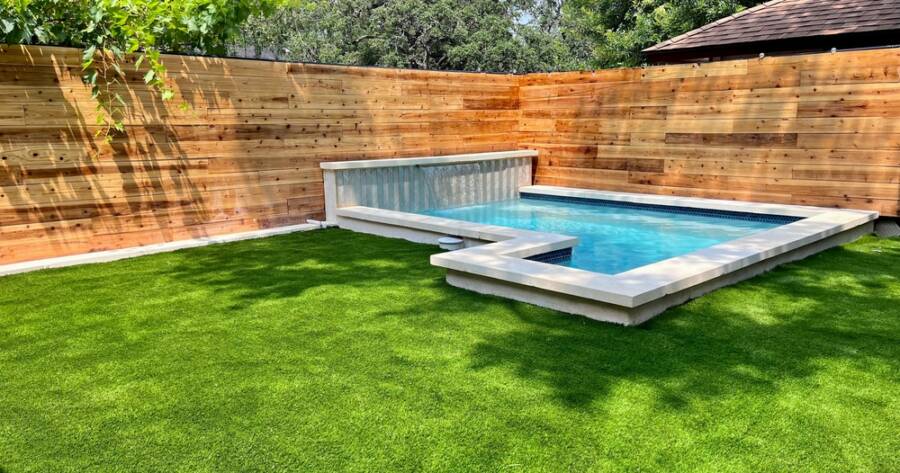
Plunge pools represent a different kind of departure from the above-ground pool tradition. Rather than prioritizing lap swimming or exercise currents, plunge pools focus on immersive relaxation and hydrotherapy in a compact, design-forward package. They’re particularly well-suited to backyards with awkward layouts or tight dimensions, transforming underused corners and oddly shaped outdoor zones into polished retreat spaces (source).
The environmental footprint of a plunge pool is notably smaller than a conventional above-ground pool as well. A plunge pool uses roughly 80% less water than a large standard inground pool and requires fewer chemicals and less energy to maintain (source). That reduction in resource consumption aligns well with the growing interest among American homeowners in sustainable and lower-maintenance outdoor living.
Plunge pools also offer design flexibility that above-ground pools simply cannot match. A semi-inground installation, for example, provides a cleaner visual aesthetic than a fully above-ground structure while remaining more budget-friendly than a complete inground build (source). Entry-level options like barrel-style cold plunge units make the concept accessible at a relatively low price point, while high-end hand-tiled concrete versions serve as genuine architectural centerpieces in premium outdoor spaces (source).
Comparing the Two Alternatives
Both swim spas and plunge pools address different homeowner priorities, which is why each has found its own enthusiastic audience. Homeowners motivated primarily by fitness, year-round usability, and energy efficiency tend to gravitate toward swim spas. Those drawn to aesthetic design, cold therapy, minimal maintenance, and creative use of compact outdoor spaces often find plunge pools more appealing.
What both alternatives share is an ability to deliver more per square foot than a traditional above-ground pool. Neither requires the large, flat, open yard footprint that full-size pools demand. Neither is limited to a single summer season of use. And both can be positioned as long-term property investments rather than seasonal accessories that sit covered under a tarp for half the year.
The Changing Backyard Landscape
American homeowners are rethinking what outdoor living should look like, and above-ground pools are increasingly being left out of those new visions. The demand for spaces that function year-round, require manageable upkeep, and serve multiple purposes has pushed swim spas and plunge pools to the front of the conversation. As lot sizes in many suburban areas continue to shrink and homeowners become more discerning about how every square foot of outdoor space is used, these two alternatives are well-positioned to continue displacing the traditional above-ground pool.
Why You Should Learn More About Above-Ground Pool Alternatives Today
The shift away from traditional above-ground pools reflects a broader evolution in how Americans think about backyard investment and outdoor enjoyment. Swim spas offer year-round fitness and relaxation in a space-efficient design with strong water quality advantages. Plunge pools deliver elegant, low-resource immersion experiences that adapt to even the most challenging yard layouts. Both options outperform above-ground pools across dimensions that matter most to today’s homeowners: efficiency, versatility, aesthetics, and long-term value. Anyone evaluating their outdoor space should take time to explore what each alternative realistically offers before committing to any installation decision.